


You have two watches.
Your first watch is analog. It has dials, gears, crystals and movements. It is a machine in the fullest sense of the word. It looks great. It tells time. If you looked inside, you would see a tiny world of complexity in motion.
Watch two is an Apple Watch. It also tells time. You can’t look inside it, and if you could, you would see nothing going on. It is a window into a cloud, and in a way, the sky is its limit. It can be updated silently on your wrist. Functions can change. It is still a timepiece, but it is more. It is a powerfully elegant foundation for trading worlds of data and providing unbelievable insights.
Your watches are two different systems: both are beautiful in their own way. The more you compare, however, the more you see they don’t have much in common — they both tell time and they both fit on your wrist.
Legacy core solutions and today’s intelligent core insurance solutions have a little more in common, but not much. The gap between them is growing every day. Legacy core systems, including new legacy or on-premise modern (highly customized), maintain the way business has been done in the past. They were architected to accomplish what was needed at the time. Over time, they moved beyond the basic clockwork and added functions, but along the way they lost a bit of elegance.
Now, they are unstable and expensive foundations, negatively impacting operational efficiencies, expense ratios, and profitability, as well as constraining talent and limiting access to data. Legacy core systems, and potentially the Zombie technology partners supporting them, now stand in the way of fulfilling the AI and Frontier Insurer potential. They are barriers to competitive business strategies and growth plans.
The alternative is an intelligent core. It makes legacy look archaic. It is complex, but elegant, and for the business, it simplifies almost everything and opens up the potential for unprecedented business opportunities.
Core Solutions: The Shift to Intelligent Core
Each year, Majesco surveys insurers to find out where they are on their transformation journey and how this plays into their business and technology strategies. We create several reports from this survey, including Leaders Reinventing Insurance: Strategic Focus on Business Operating Model and Technology Foundation.
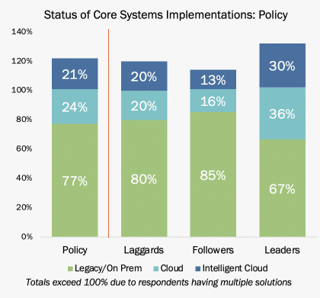
Our current data shows that policy solutions remain heavily anchored in legacy/on prem solutions at 77% overall, as well as with Leaders, Followers and Laggards, as shown in Figure 1. However, Leaders show a major shift in significantly higher adoption of cloud-based core, but more importantly to intelligent core (also in the cloud but with embedded AI), positioning them to more readily embrace the adoption of new technologies and AI.
The segment contrast tells a fortuitous story: While Leaders’ legacy share (67%) is still high, their move to Cloud (36%) but more importantly, the move to Intelligent core (30%) highlights their strategic focus and execution toward a new technology foundation that will drive new business value and address significant operating model challenges.
In contrast, Followers (85%) and Laggards (80%) remain on legacy. However, when it comes to insurance cloud migration, Laggards are outpacing Followers slightly in the move to cloud or intelligent core. This is a positive move to attempt to leap forward with a new foundation to drive growth, innovation and optimization.
Totals exceeding 100% for insurance policy administration systems reflect the reality for most insurers who have multiple policy solutions in play, which itself is an important interpretation—many insurers are living with hybrid, overlapping architectures that often drive cost and complexity.
Leaders are prioritizing building new technology foundations.
Policy transformation is still a work in progress even for Leaders, but they are clearly accelerating a focus on building a new technology foundation needed for speed to market, customer engagement, data access, and AI-enabled workflows.
Insurance executives should consider cloud, AI-native policy solutions as a strategic anchor that drives new levels of operational efficiency that subsequently drives down expense ratios and improves product pricing. Just moving to the cloud is now a step behind where the industry is rapidly going to AI-native core.
Without an intelligent core, insurance business transformation is difficult. It will be nearly impossible to launch new products quickly, deliver consistent digital experiences, and operationalize intelligence across underwriting, billing, claims, servicing, and customer engagement.
How can insurers transform legacy core systems without disrupting operations?
Rationalizing overlapping systems and standardizing on cloud AI-native platforms with ease of upgrades and embedded intelligence will reduce operational cost and complexity. Those who prioritize a pathway to this goal and accelerate transformation will see increased operational value and competitive differentiation in a rapidly changing market. Overlapping is necessary, but what can happen to insurers is that they take too long to make a total shift and become doubled up on programs and expenses. At some point, legacy systems must be completely transitioned out of the business model.
Figure 1: Status of policy core system implementations.
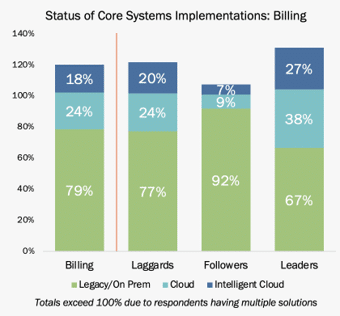
Billing reflects the starkest technology divide, as seen in Figure 2.
Leaders again demonstrate a lower legacy footprint and substantially higher cloud (38%) and intelligent core (27%) adoption, while still carrying legacy.
Surprisingly, Followers are the most anchored in legacy/on-prem (92%), with very low cloud (9%) and intelligent core (7%), suggesting they may be constrained by customization, legacy integrations, or prior billing investments that are difficult to unwind.
Laggards, while heavily on legacy (77%), outpace Followers with cloud (24%) and intelligent core (20%), demonstrating once again the opportunity to outpace or leapfrog Followers in their ability to transform their business and technology foundation, putting them at a potential advantage by closing the gap with Leaders.
Billing is a critical operational battleground because it is the service touched most frequently by customers, influencing customer satisfaction and loyalty. It is becoming an AI leverage point to reduce manual exceptions, ingest bills for claims payouts, optimize collections workflows, and enable consistent and quality service.
Insurance executives must leverage cloud AI-native platforms as an advantage to strengthen and deliver quality, consistent, and cost-effective service. It offers a fast path to measurable operational outcomes — fewer manual touches, improved customer experience, and reduced expense.
Figure 2: Status of billing core systems implementation
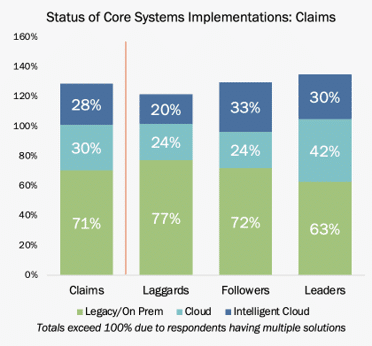
Claims transformation was the first focus in the early 2000’s, which is reflected in the high level of legacy/on prem solutions at 79%, seen in Figure 3. Cloud migration began in 2017-2018, but due to the high customization of the on-prem solutions, it has been costly.
Leaders show the lowest legacy share (63%) and the highest cloud (42%) and intelligent core (30%) adoption, accelerating a new era of claims transformation. Leaders’ higher intelligent core adoption demonstrates building the technology foundation with embedded AI/automation in claims triage, workflow routing, document handling, and proactive communications.
In contrast, Followers (72%) and Laggards (77%) remain heavily on legacy/on prem. Encouragingly, Followers show a strong move to the cloud (24%) but an even stronger move to intelligent core (33%). Followers’ intelligent core presence hints at focused transformation that could become a platform for broader change if it’s integrated well; otherwise, it risks becoming yet another silo.
Laggards show a similar move to cloud (24%) but a much smaller move to intelligent core (20%) as compared to their peers, creating a major drag on operational efficiency, flexibility and data-driven improvement.
These results highlight that claims are becoming a primary transformation wedge for some organizations — likely because claims cost and cycle-time pressures are so visible and because digital claims experiences are critical to trust and retention.
Leadership teams should respond by treating claims transformation as both an efficiency and experience strategy: modern cloud AI-native platforms, unified data, and embedded intelligence are how insurers reduce leakage, improve cycle times, and improve customer satisfaction—especially as catastrophe frequency and severity continue to pressure the system.
Figure 3:Status of claims core systems implementation
Operational Systems: Following the Shift
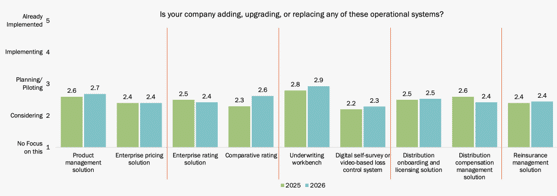
Year-over-year movement across a range of operational systems is modest and, in several areas, flat to slightly down, as seen in Figure 4 — reinforcing that many insurers are still focused on core and selectively modernizing these other systems.
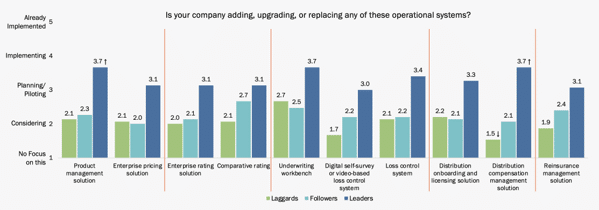
Comparative rating stands out as one of the more active areas, with underwriting workbench remaining a priority area, reflecting continued pressure to compete based on rapid rating, quoting and binding in the market as risk changes, as well as to hone in on improved underwriting to drive profitability.
Most of the other systems—enterprise pricing/rating, product management, distribution onboarding/ licensing, compensation management, and reinsurance management — remain at the “considering” to “planning/ piloting” stage. The potential issue with not addressing these areas is that they directly influence speed, accuracy, channel growth and ease of doing business.
The business impact for insurers is that these systems are often homegrown or legacy, forcing them to rely on manual workarounds, partial solutions, or “good enough” other options like spreadsheets.
With intensified pricing and rating volatility, higher operational cost scrutiny, and rising expectations from distribution partners, this is a call for insurance executives to take action to connect the dots.
Fragmented legacy solutions greatly hinder both enterprise agility and operational efficiency. Executives should align and prioritize operational system transformation across end-to-end value streams with their work on core to more holistically transform the operating model, ensure data flows across systems, and help prioritize where AI can be embedded into the workflows. Otherwise, insurers will struggle to translate investments into measurable operating results.
Figure 4: Insurers’ level of activity in adding, upgrading, or replacing operational systems
Leaders are consistently ahead across every operational system, often pushing into planning/piloting and implementing phases. Leaders’ elevated activity in distribution onboarding/licensing and compensation reflects an understanding that agent/broker experience is a growth lever, not a back-office concern. These systems affect appointment speed, accuracy, and ease of doing business. Leaders are also stronger on underwriting workbench transformation — an operational necessity in a market that demands speed, precision, and broader data usage.
If AI is the future, are platforms prepared to support it?
In contrast to Leaders, Followers and Laggards are significantly behind, often hovering near “no focus” to “considering”— highlighting sharp gaps in transformation and creating additional competitive risk. In particular, Laggards’ low activity, even as compared to Followers, suggests that even if they adopt pockets of AI experimentation, they may not have the technology platforms capable of using it, let alone scaling it to create operational value.
Figure 5: Levels of activity in adding, upgrading, or replacing operational systems by Leaders, Followers, and Laggards
The implication is clear: priorities have to be in the right order.
Operational and technology transformation is becoming a differentiator. Without it, the operationalization of AI — where documents are processed, decisions are guided, exceptions are managed, and distributors and customers feel the difference — is difficult at best and unachievable at worst.
Leaders must continue establishing their technology foundation with intelligent, integrated operational solutions across that value chain that reduce friction, increase automation, and drive operational excellence. Prioritizing these operational systems alongside core can unlock immediate ROI in underwriting workflow, rating/pricing, and distribution enablement, and accelerate the potential of AI adoption.
How do insurers select a policy administration system or any core system?
McKinsey research indicates that even high-performing companies have a 30% gap between their strategy’s full potential and what is actually delivered, which can be attributed to shortcomings in their operating models.
One of the fundamental issues bedeviling insurance leaders is a lack of priority and clarity on where to focus their transformation initiatives. The rising interest in AI has further complicated the situation. While there is yet much to understand about AI potential, garnering the projected value requires a new operating model on a Cloud- and AI-native technology foundation — an intelligent core that together positions them as a Frontier Insurer.
Often all that is needed is clarity — the kind that can come when involving a technology partner that is already leading insurers on their journeys from legacy to transformation.
Everything hinges on technologies that can rewrite operations and energize business models. That’s why Majesco steps out of traditional vendor partner practices to research and develop the next generation of insurance core systems. We help insurers assess priorities, align initiatives and fulfill their goals — taking on transformation with confidence.
Are you ready for clear and confident steps toward intelligent core and business transformation? Contact Majesco today for a conversation about how we help you to move from your current state to the place your organization needs to be.
Transitioning to a new operating model is necessary but is not without risks. It must take advantage of groundbreaking technologies, such as IoT, AI, next-gen intelligent platforms, and others, to redefine and optimize new business processes and methodologies. For more background, check out another Majesco Thought Leadership report, Strategic Priorities 2026: The Frontier Insurer in the Intelligent Era of Insurance, and tune in to one of our informative webinars, such as The Insurance Alignment Gap: How Insurers Can Turn Business Transformation into Customer-Relevant Value.