





Blog
How Agentic AI Will Improve Customer Engagement in Insurance

In North America, the World Cup is in full swing. With it, we can draw lessons from AI and contextual advertising to help insurers engage with customers.
First, soccer’s “on-pitch” advertising is in your face for the entire game. A ring of digital boards surrounds the soccer field. Animated ads run up and down the field throughout the game. They don’t stop for anything. They are a part of the experience. This counters one of soccer’s common issues — there are very few breaks within a game to roll television ads.
What most viewers don’t know is that the ads running in the stadium may not be the ones that they are viewing. Before the game, the screens are blacked out, television cameras are calibrated against AI-powered software and the scene is set for contextualized ads. During the game, across televised networks, digital ads are superimposed over the in-stadium ads. For worldwide televised events, such as the World Cup, AI-driven, contextualized ads are game-changers. Every region can have its own advertising that fits its target markets. As time goes on and contextualization improves, viewers will likely receive only ads that are relevant to them. Customer engagement will find a new pinnacle — without the reliance upon a first touch from a human agent.
Savvy insurers are already using soccer ads to their advantage. But what if they could use Agentic AI and contextualized communication to drive engagement right now?
How will Agentic AI improve customer engagement in insurance?
Customer engagement expectations are continuing to rise, often driven by an increased protection gap that requires a high-touch strategy. People need to see, learn and understand how different their lives or businesses can be (less stressful, more satisfying) when they know they are covered. In insurance, this strategy may now be fostered through AI. With a prepared framework, Agentic AI will take data signals and tailor approaches and messaging to better engage and inform customers. To understand the why, it will help to distinguish the current norm in customer engagement and weigh it against customer sentiment — an area where Majesco has current research data available.
Why traditional customer engagement in insurance is failing customers
Insurance is experiencing a widening protection gap. Increased insurance costs across nearly all lines of business are unsustainable for customers, forcing them to make difficult decisions such as not buying insurance, switching to a lower cost, increasing deductibles, and more.
Customers are also becoming disillusioned with the “traditional” insurance approach, creating a trust and loyalty fault line between customers’ expectations and insurers’ ability to deliver what they want and need at a price they can afford. Customers increasingly have no guaranteed loyalty to old models, even from trusted brands.
But most of these customers aren’t “in contact” with the products and services that make the most sense for their location, occupation, life phase, or employment. They know that they have needs and worries, but they can’t connect the dots because insurers haven’t truly exposed them or educated them about products and services that are different and meaningful. If they are educated in the right way at the right time, customer engagement can improve…possibly even simmer with excitement as people move from positions of insurance disillusionment to insurance relevance and approachability.
Majesco recently surveyed U.S. customers about what matters most to them: maintaining their health, protecting their families, managing rising financial pressures, and staying secure in an increasingly uncertain world. The research reveals a consistent and troubling disconnect between the importance customers place on these risks and how prepared or protected they feel to manage them. These “protection gaps” appear across lifestyle, financial, and safety/security risks—and in many cases, are substantial.
Cost pressures and other hurdles aside, most customers do not completely understand financial protection and products well enough to make choices that will give them peace of mind.
In Majesco’s recent thought-leadership report, Closing the Insurance Customer Protection Gap: How Generational Differences in Risk, Readiness, and Coverage are Redefining Insurance Value, we found that explicitly asking customers whether certain products would help them feel more prepared yielded strong results. Among respondents who do not currently have protective products that fit their needs, many believe they would materially improve their sense of protection — especially in financial and health-related areas.
This reinforces the idea that protection gaps are driven less by resistance and more by awareness, accessibility, and relevance. Customers are open to solutions when they are clearly connected to the risks they care about.
Using AI to Educate and Inform
As insurers look to close persistent protection gaps, artificial intelligence (AI)—including GenAI and Agentic AI—is emerging as a critical enabler, not just for internal operational efficiency, but for customer understanding, confidence, and engagement. The research reveals that customer attitudes toward AI are evolving positively, with year-over-year improvements in acceptance across a wide range of companies and insurance-specific use cases, creating an opportunity for insurers to bridge the protection gaps through innovative engagement.
Customer sentiment and insurance needs are different for each generational group. By using AI to deliver personalized engagement and education, insurers can help customers understand the risks they face and the solutions available to them, framed in the context of their life stage, priorities, and behaviors. AI-driven recommendations can translate abstract risks—such as retirement shortfalls or cyber exposure—into concrete, actionable insights that feel relevant rather than overwhelming.
Leveraging Artificial Intelligence to Close the Protection Gap
In BCG’s February 2026 report, Competing for the AI-Empowered Insurance Customer, they noted “a YouGov survey found that more than 90% of customers now use GenAI tools weekly, and about 40% say they trust the information these systems provide. Roughly 20% of purchasing decisions are already influenced by AI. The result is that customer journeys are increasingly steered by an AI adviser.”[i]
As insurers look to close persistent protection gaps, artificial intelligence (AI)—including GenAI and Agentic AI—is emerging as a critical enabler, not just for internal operational efficiency, but for customer understanding, confidence, and engagement.
The research reveals that customer attitudes toward AI are evolving positively, with year-over-year improvements in acceptance across a wide range of companies and insurance-specific use cases, creating an opportunity for insurers to bridge the protection gaps through innovative engagement.
Improving Attitudes Toward Companies’ Use of AI
Customer perceptions of companies’ use of AI continue to trend positively year over year, with clear generational differences in both baseline sentiment and momentum. These generational differences can affect insurance engagement, and yet there are signs that Agentic AI can be used to overcome engagement problems in both cohorts.
Across nearly every company type, Gen Z & Millennials report more favorable views of AI use than Gen X & Boomers in both 2025 and 2026. Yet, improvement in both cohorts signals an opportune time for AI-driven education and contextualization.
Younger customers are most comfortable with AI in digitally-native and data-intensive contexts—such as music and video streaming services, Amazon, investments, and home security devices—where average ratings rise to just under the somewhat positive range in 2026.
Notably, Gen Z & Millennials show some of the largest year-over-year increases in:
- Investments (3.0 to 3.5)
- Bank accounts (2.8 to 3.2)
- Home security services (3.1 to 3.5)
This signals growing trust and the likely use in AI-driven personalization, automation, and intelligence in financial and security-related experiences. (See Figure 1.)
Gen X & Boomers show incremental improvement, though from a lower baseline and at a slower pace.
Sentiment among this cohort remains more cautious, clustering closer to neutral across insurance, banking, and investment providers. Still, year-over-year gains are evident, particularly for group and voluntary employee benefits (2.6 to 3.0), home security services (2.7 to 3.1), and mainstream digital platforms such as Amazon and streaming services.
Traditional financial services—bank accounts and investments—remain the most resistant to attitudinal change for older customers, with minimal movement year over year.
Figure 1: Customers’ perceptions of AI use by companies they do business with
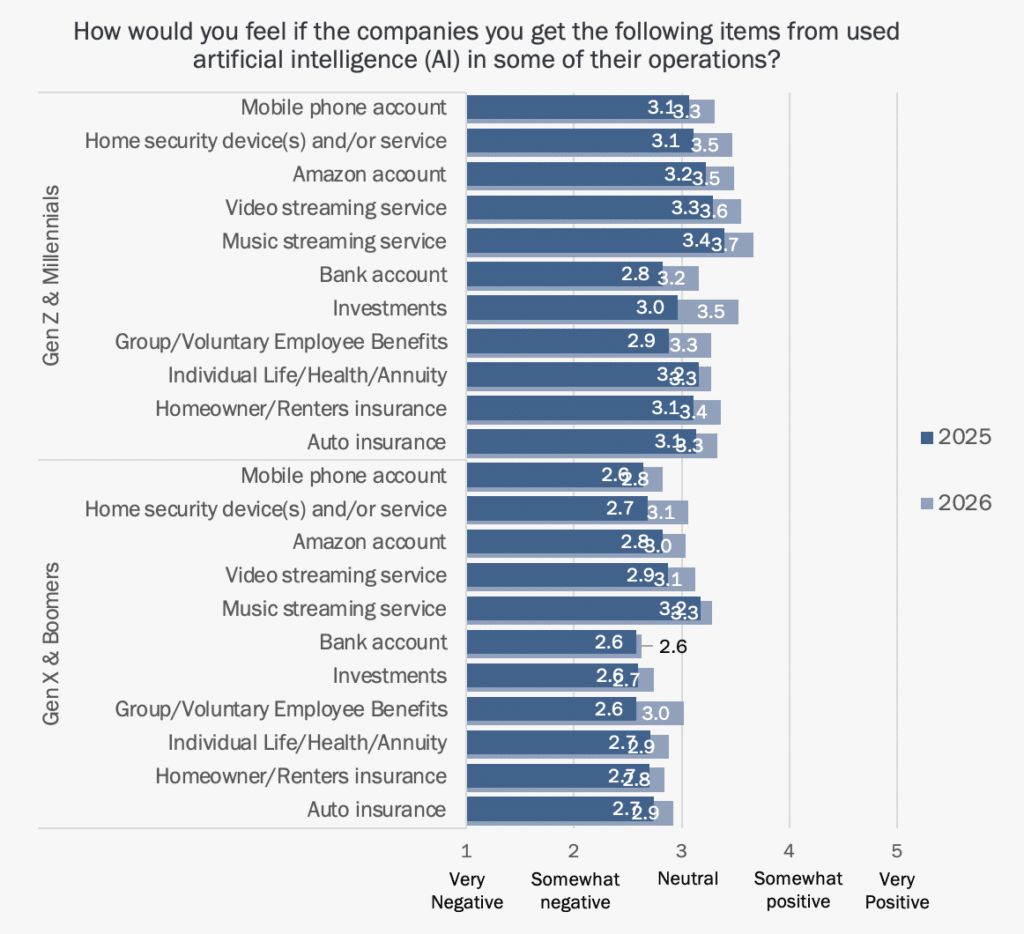
Overall, the data suggests that AI acceptance is broadening across generational groups, but insurers and financial institutions must earn trust differently by generation—leveraging familiarity and transparency for older customers while continuing to meet younger customers’ expectations for intelligent, seamless digital experiences.
Rising Acceptance of Agentic AI in Insurance-Specific Use Cases
Customer perceptions of insurers’ use of AI vary meaningfully by generation and by where AI is applied across the insurance value chain. Majesco asked customers what they thought of an insurance company’s use of AI in certain operations. (See Figure 2.)
Gen Z & Millennials consistently view AI more favorably than Gen X & Boomers across every stage, with ratings approaching the probably would level and modest but consistent improvement from 2025 to 2026.
The strongest positive movement for younger customers appears in operational and experience-oriented areas—speeding claims payments, improving claims reporting and communication, enhancing pricing accuracy, and simplifying data input—all of which show year-over-year gains. These results indicate that Gen Z & Millennials increasingly associate AI with faster, clearer, and more convenient insurance interactions.
By contrast, Gen X & Boomers’ perceptions remain largely flat, clustering close to neutral across most value-chain stages.
While this segment does not express negative sentiment toward AI, there is little year-over-year improvement, except for a slight uptick in perceptions around easier data input. This suggests a more cautious, proof-driven mindset in which AI’s value must be demonstrated through tangible outcomes rather than promised efficiency.
Figure 2: Customers’ perceptions of AI use by insurance companies
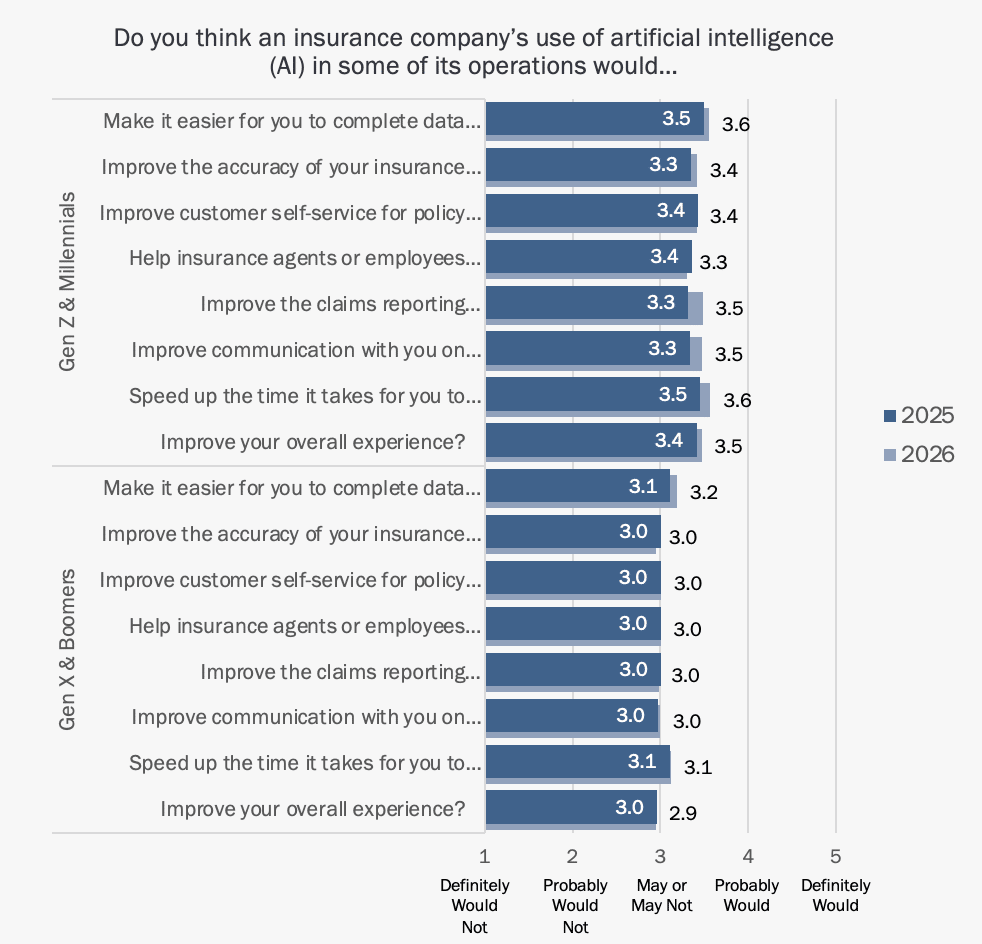
Overall, the findings reinforce that AI adoption in insurance is unlikely to generate uniform customer enthusiasm; instead, insurers must tailor how AI is positioned and used—leveraging speed, self-service, and personalization for younger customers while emphasizing reliability, accuracy, and human augmentation to build trust with older ones. Asking, “what ways can we introduce AI-led education and engagement tools without promoting it?” may be relevant. After all, automated, rules-based questioning has been in use for decades. Leading with “non-intrusive” suggestions and questions may lead to normalized engagement and improved trust.
Agentic AI as a Bridge Between Concern and Action
The protection gaps identified throughout this research are not solely the result of missing products; they are driven by gaps in understanding, confidence, perceived relevance and value. AI presents insurers a powerful opportunity to address these challenges at scale, with consistency and quality.
By using Agentic AI to deliver personalized engagement and education, insurers can help customers understand the risks they face and the solutions available to them, framed in the context of their life stage, priorities, and behaviors. AI-driven recommendations can translate abstract risks—such as retirement shortfalls or cyber exposure—into concrete, actionable insights that feel relevant rather than overwhelming.
AI can also play a central role in building trust by improving quality, transparency and responsiveness. Faster claims resolution, clearer communication, and more intuitive self-service experiences reduce friction at moments that matter most, reinforcing the value of insurance before and after a loss occurs.
Importantly, AI can help insurers move from awareness to adoption. The research shows that many customers believe certain products would help them feel more protected, yet adoption remains limited. AI-enabled engagement can close this gap by:
- Identifying customers most exposed to specific protection gaps
- Recommending relevant products and services at the right moment
- Simplifying enrollment and ongoing management
- Continuously reinforcing the value delivered over time
When AI is used to connect the dots between concern, solution, and outcome, it can help transform insurance from a reactive purchase into a proactive partnership.
The growing acceptance of AI creates a timely opportunity for insurers to rethink how they engage customers around protection gaps, creating deeper and more loyal relationships. Rather than positioning AI solely as a back-office efficiency tool, insurers should increasingly view it as a front-office capability that enables education, personalization, and trust at scale.
Insurers that succeed will be those that apply AI, GenAI, and Agentic AI deliberately—using it to make risk more understandable, solutions more accessible, and protection more tangible. In doing so, AI becomes not just a technology investment, but a strategic lever for closing the protection gaps this research has surfaced, and a growth driver for insurers.
Time to communicate
Of course, the use of Agentic AI needs a greater outlet than simple reliance upon insureds and uninsureds to interact and engage with insurers. Outward insurance communication is now more vital than ever. For insurers to grow AI in its acceptance, they must build a framework that utilizes AI across internal and external functions, enabling the sales and marketing organizations to reach further into lives and businesses with details and communications that are relevant and needed.
Majesco is leading the way in bringing AI to insurers in holistic, visionary ways that will enable insurers to grow their business and shrink protection gaps. Customer engagement has always been crucial to insurers, but now that engagement comes much closer to the ideal partnerships insurers have long wanted. In a time when brand loyalty is shrinking and price constraints are driving customers to price-shop or leave their coverage behind, AI-driven customer engagement can give insurers new ways to improve loyalty, lower costs and provide more relevant products and services.
Are you ready to improve customer engagement in insurance? Let Majesco show you how we are using AI to transform insurance business models, making insurance relevant to customers now and for the future. Find out more about our recent customer survey and be sure to view our webinar on Closing the Insurance Gap: How Generational Differences in Risk, Readiness, and Coverage are Redefining Insurance Value.
[i] Candreia, Angelo, et al., “Competing for the AI-Empowered Insurance Customer,” Boston Consulting Group, February 3, 2026, https://www.bcg.com/publications/2026/competing-for-the-ai-empowered-insurance-customer