





Blog
Why Retirement and Pension Administrators Are Modernizing on the Cloud Now – The Business and Member Value Operational Efficiency, Security, Scalability and Member Engagement

Retirement and pension administration is well into a structural transformation phase. Public pension systems, Taft-Hartley funds, corporate retirement plans, and insurers supporting Pension Risk Transfer (PRT) are facing a convergence of pressures: demographic expansion, increasing regulatory oversight, heightened cybersecurity risk, increasing operational efficiency pressures, and rising expectations for digital member engagement. These structural trends are reshaping operational business and technology foundation requirements across the retirement and pension ecosystem.
Legacy administration business processes and technology platforms were not designed for this shift. Fragmented data architectures, manual workflows, infrastructure-heavy operating models, and periodic, expensive upgrade cycles limit agility precisely when retirement and pension organizations require scalability, automation, digitalization, intelligence, and continuous innovation. As a result, modernization is increasingly viewed as a fiduciary and strategic imperative.
Cloud-native retirement and pension platforms are the dominant modernization approach. With expanded investment following the Majesco acquisition, industry attention has intensified around unified retirement administration platforms combining automation, AI, cybersecurity resilience, and digital engagement capabilities.
Economic Foundations of Modernization
Benchmarking from Deloitte suggests that 60–80% of traditional enterprise application lifecycle spending is tied to maintenance, infrastructure support, and staffing rather than innovation.³ For retirement and pension administrators managing legacy platforms, these dynamics constrain investment in member experience, strategic growth initiatives and AI capabilities.
Because of this, the financial rationale for modernization only strengthens.
- Research from Gartner indicates organizations migrating core enterprise systems to cloud environments commonly realize infrastructure cost reductions in the 30–50% range.¹
- Complementary lifecycle analyses from IDC show total cost of ownership reductions frequently approaching 60–70% for SaaS enterprise platforms over multi-year horizons.²
Cloud-native administration software shifts the economic model toward predictable operating expense structures while reducing infrastructure volatility, while also taking advantage of the expertise of the software provider to provide new levels of support, including upgrades. For organizations managing large participant populations or expanding into institutional retirement markets, this financial predictability is increasingly strategic.
Automation as a Primary ROI Driver
Automation and AI-enabled workflows have become central drivers of retirement and pension administration modernization value. Studies from McKinsey & Company indicate financial institutions adopting AI report productivity improvements typically in the 15–25% range.⁴ Meanwhile, Everest Group automation benchmarking shows operational cost reductions of approximately 25–40% in transaction-intensive administrative environments.⁵
In retirement and pension administration, these gains manifest through straight-through eligibility processing, automated benefit calculations, faster reconciliation, and improved reporting accuracy. Digital self-service capabilities further reduce administrative overhead while improving member engagement.
The combined effect is improved operational efficiency, reduced operational expenses, reduced error rates, enhanced compliance transparency, and better participant experience.
Cybersecurity and Fiduciary Risk Considerations
Cybersecurity is a central modernization driver across financial services, including for retirement and pension administration organizations responsible for sensitive financial and personal data.
Research from IBM Security in partnership with the Ponemon Institute estimates the average financial services data breach cost at approximately $5.9 million globally.⁶ Concurrent research from Celent shows financial institutions continuing to increase cybersecurity investment year over year.⁷
Cloud-native administration platforms incorporate zero-trust architectures, continuous monitoring, identity verification modernization, automated patching, and integrated disaster recovery managed and continuously invested in by the solution provider. These capabilities materially reduce operational risk while strengthening fiduciary confidence and regulatory compliance posture.
Pension Risk Transfer Growth as a Modernization Catalyst
Pension Risk Transfer activity has emerged as a significant acceleration factor for modernization. Insurers and retirement administrators participating in the PRT market are not only seeing increased deal volume but also markedly greater transaction complexity. Deals are becoming larger, more customized, competitive, and operationally intricate, making reaction time and operational efficiency increasingly critical. Administrators must be able to ingest, validate, and operationalize large participant datasets quickly while maintaining actuarial accuracy, regulatory compliance, and a seamless member experience.
Industry discussions featuring insurers such as MassMutual, Pacific Life, and MetLife consistently emphasize that scalable administration infrastructure, strong data governance, and automation capabilities are essential for executing institutional annuity transactions efficiently. Rising interest rate volatility, regulatory developments, and continued sponsor interest in pension de-risking are sustaining market momentum.
At the same time, larger transaction sizes, competitive bids, and compressed execution timelines mean scalability is no longer optional — platforms must handle significant onboarding volumes, complex benefit structures, and high transaction throughput with new levels of operational efficiency.
Beyond operational efficiency, modernization of Pension Risk Transfer administration platforms is increasingly viewed as a broader strategic imperative. More insurers see expansion into the institutional retirement and pension risk transfer market as a diversification strategy that complements traditional life and annuity business lines. Modern, scalable administration infrastructure enables insurers to participate more competitively in this growing retirement ecosystem while supporting long-term revenue diversification and balance sheet stability.
Operational readiness and efficiencies are increasingly viewed as a competitive differentiator both in the bid process and in operational execution. Organizations able to onboard large participant blocks rapidly while maintaining data integrity, compliance oversight, and service continuity are better positioned to capture institutional retirement opportunities. Cloud-native retirement and pension administration platforms provide the automation, analytics integration, and operational scalability required to support this growth.
Practitioner Validation: Improved Member Outcomes
Industry practitioners consistently emphasize that modernization must ultimately improve outcomes for members and beneficiaries. As Rick Silva, Executive Director of UFCW & Employers Trust, noted in discussing modernization initiatives:
“Modernizing pension administration isn’t just about technology — it’s about improving service, accuracy, and trust for the people who depend on these benefits.”
This perspective aligns with reported outcomes from modernization programs across retirement and pension administrators and PRT insurers: improved reporting transparency, faster service response, greater operational resilience, and enhanced member confidence.
Business Value Model for Retirement Pension Administration Modernization
Across enterprise-scale retirement and pension organizations, modernization typically generates measurable value across several interconnected domains.
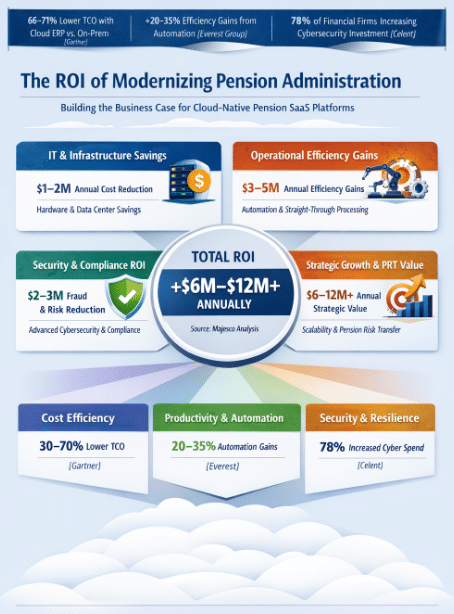
- Infrastructure optimization – This frequently produces annual savings in the $1–2 million range through elimination of hardware refresh cycles, reduced data center staffing, and maintenance efficiencies.
- Automation-driven operational improvements – These contribute an additional $3–5 million annually through straight-through processing, reduced reconciliation workload, and faster onboarding of Pension Risk Transfer business.
- Cybersecurity modernization – Provides risk-adjusted financial value often estimated at $2–3 million annually through breach risk mitigation, fraud prevention, and compliance efficiencies. Governance, reporting, and audit improvements can add several hundred thousand dollars annually in additional operational savings.
Taken together, many large pension organizations report total measurable ROI in the $6–12 million annual range, with strategic benefits extending beyond direct financial metrics.
Case Study Sidebar — UFCW & Employers Trust
Challenge: Administration complexity associated with multiemployer pension programs and legacy infrastructure constraints.
Modernization Focus: Automation, digital engagement, data transparency, operational resilience.
Observed Impact: Improved service accuracy, faster processing, stronger reporting transparency, enhanced member trust.
Leadership Perspective: Modernization viewed as essential to fiduciary performance and long-term retirement system sustainability.
Strategic Outlook
Industry experts, analysts and leaders consistently identify cloud-native core platforms, automation, cybersecurity investment, AI investment, and data modernization as foundational to the future of financial services administration.
Majesco’s established leadership in AI and continuous innovation across the markets they serve highlights the commitment and strategic focus that extends to the Retirement and Pension market solutions. An intelligent Retirement and Pension platform supporting automation, AI, analytics, digital engagement, and scalable infrastructure for the broader retirement and pension ecosystem transformation.
The industry conversation is no longer whether modernization is necessary … it is how quickly they can modernize to achieve measurable business value that will position them competitively in an increasingly shifting market.
Future viability is dependent on long-term operational resilience.
Footnotes & References
- Gartner, Public Cloud Services Forecast and Infrastructure Cost Optimization Studies.
- IDC, Business Value of Cloud and SaaS Enterprise Applications Research.
- Deloitte, Application Modernization Benchmarking Reports.
- McKinsey & Company, Global AI Adoption Surveys.
- Everest Group, Intelligent Automation PEAK Matrix Assessments.
- IBM Security & Ponemon Institute, Cost of a Data Breach Report.
- Celent, Financial Services IT Spending Research.