


What is business transformation in insurance?
Insurance business transformation is an operating model and technology foundation shift that allows organizations to advance data and AI capabilities, optimize operations, create agility to respond to market changes, and empower speed to market for new products — fueling growth and lowering costs. How it is accomplished can take many forms, but the key ingredients are strategic priorities that are aligned — aligned with a new operating model redesigned for the future and with the necessary technology foundation.
When it comes to business transformation in insurance, growth follows execution on strategic priorities.
Growth isn’t accidental. It’s earned through deliberate strategy and execution. It’s a measurable advantage.
Within a broad spectrum of insurance companies, there is a powerful and consistent relationship between strategic activity and growth outcomes. Across every major strategic activity — replacing core systems, introducing new products, developing new business models, expanding channels, reallocating resources, and focusing on innovation—companies that engage at higher levels experience meaningfully stronger growth.
These strategic activities are not one-off boosts, but rather compound over time, creating a widening gap between those who act and those who don’t. How do we achieve sustained, compounding growth? It is by redefining the business of insurance, including the operating model and technology foundation, to fit the future, not the past.
What does it take to engage all of the gears to make business transformation happen?
Does it take vision? Does it take follow-through on SMART goals? Does it take investment?
It takes all of these, but for a good look at how insurers are defining and executing on their strategic priorities, it may be best to follow growth patterns to discern how growing insurers are invested and how much growth they have generated.
Majesco’s findings are outlined in our thought-leadership report, Strategic Priorities 2026: A New Era of Innovation and Disruption Offers Real Business Value. For an insightful, broad look at these priorities, be sure to read the report. In today’s blog, we’ll look more closely at the evidence for targeted investment and execution around an insurer’s strategic priorities. Knowing this, should companies remain passive or quickly become proactive in their approach to strategic alignment of priorities to execution? The answer is YES!
Six Years of Data: The Insurance Business Transformation Trends That Actually Drive Growth
After six years of tracking between Leaders, Followers and Laggards, Majesco has found that insurers who made greater investments in six particular strategic activities consistently achieved higher growth multiples than their lower-activity counterparts. Every strategic lever clearly shows that the companies that act boldly outperform those that move cautiously.
What drives growth for insurance companies?
Companies that reported higher levels of strategic activities also reported higher growth. (See Figure 1.)
Insurance business transformation growth rate according to Majesco’s report:
- Insurers with more focus on innovation grew at 1.67x.
- Insurers actively replacing core systems grew at 1.37x the rate of their lower-activity peers.
- Insurers driving new product changes grew at 1.43x.
- Insurers implementing new business models grew at 1.33x.
- Insurers focused on expanding channels grew at 1.38x.
- Insurers reallocating resources achieved a 1.1x uplift in growth.
Figure 1: Strategic activities’ impact on growth
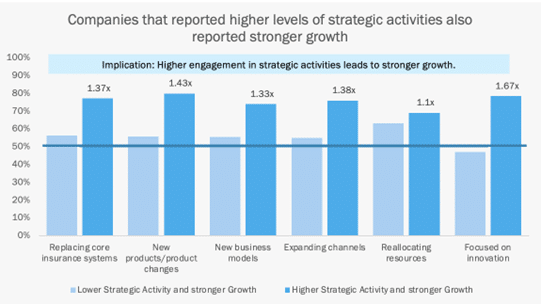
The message is clear: growth is directly tied to a strategic plan for structural modernization, including investment and execution —in simple terms—follow-through. Growing insurers focus on a new operating model and technology foundation that enables them to innovate, bring new products to market and expand channels for market reach.
This finding reinforces one of the clearest patterns in business transformation in insurance today: passive organizations rarely grow, while proactive organizations focused on strategy and execution consistently outperform.
Why is business transformation in insurance?
The multi-year trend analysis in Figure 2 deepens the insight: the growth advantage of strategic activity is not a one-year anomaly—it is persistent, widening, and compounding. Its primary benefits are improved growth, profit, lower costs and better market positioning for the future.
Figure 2: Trend in strategic activities’ impact on growth
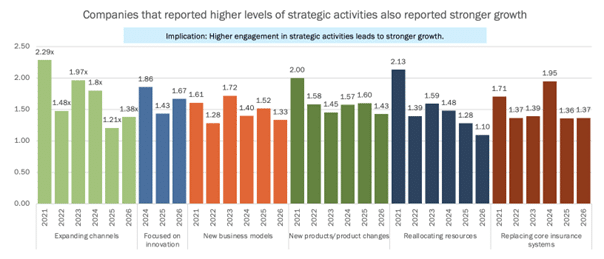
This highlights the urgent need for insurers to be bold and change. There is great potential in reinventing the business operating model and technology foundation that can more easily adapt to the challenges, opportunities, and changes in the industry. While insurance is risk-averse, it should be apparent that not changing creates greater risk for the company.
What are the challenges of business transformation in insurance?
One of the greatest challenges for insurers is resetting their culture to prepare for change. Peter Drucker was famous for this alleged quote: “Culture eats strategy for breakfast.”
Great company culture starts at the top and creates alignment between employees and management on direction, how to deal with challenges and change, where to focus time and investment, and how to respond creatively and innovatively to drive positive execution and results.
Many companies, however, are still wrestling with finding this cultural alignment. It takes time to change directions and innovate — but it takes even more time when the culture wasn’t built to support change initiatives with a flexible structure, technically and operationally.
Operating models are still a hurdle (for everyone).
McKinsey research indicates that even high-performing companies have a 30% gap between their strategy’s full potential and what is actually delivered, which can be attributed to shortcomings in their operating models.[i]
As we saw in the comparison of Leaders to Followers and Laggards, growth and success were nurtured through a focus on strategic initiatives and the execution of them, which has created consistent momentum over many years, propelling Leaders to greater heights and distinguishing them from their peers who fall behind as Followers or Laggards.
The right focus on strategic initiatives can create market-beating results and open the door to a wonderland of possibilities that enable agility, scale, operational optimization, and innovation in a fast-changing market and a new era of insurance.
Insurance Business Transformation is No Longer Optional — The Numbers Prove It
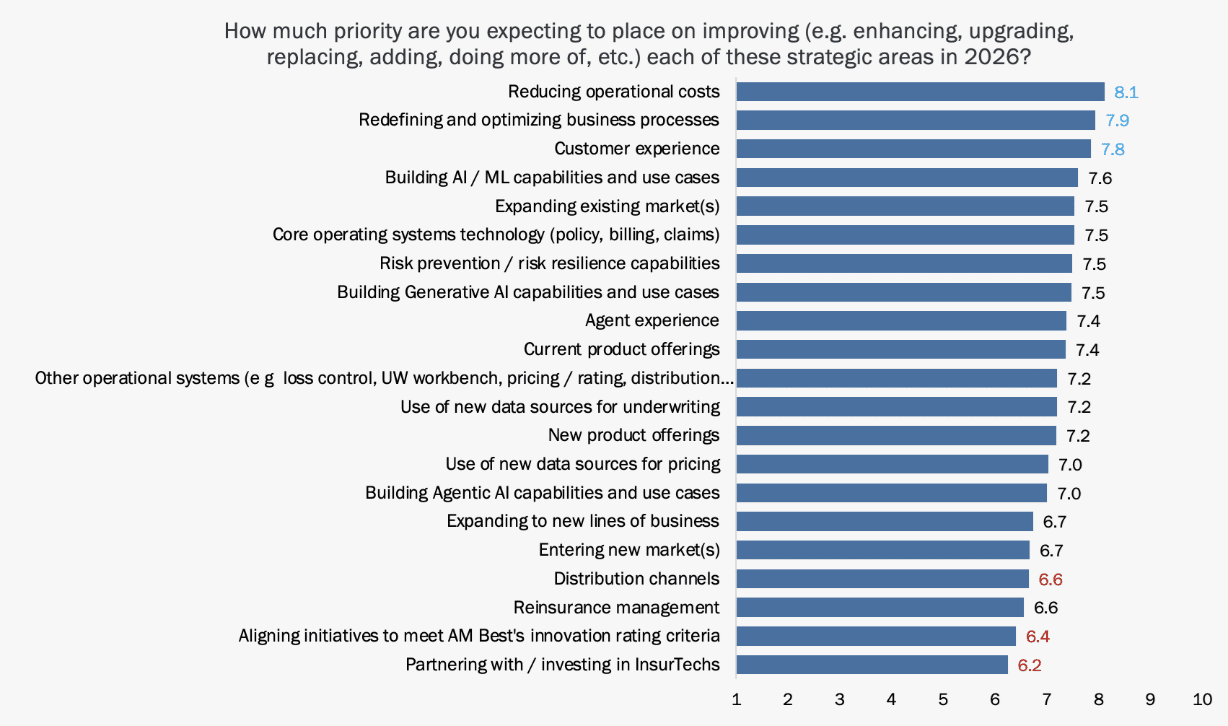
Insurers’ 2026 priority landscape, shown in Figure 3, reveals a decisive shift toward operational efficiency, process optimization, and AI-enablement—signaling a shift to a new intelligent business foundation that drives new levels of productivity, scalability, operational optimization, and business value.
The highest eight priorities cluster in the 7.5–8.1 range on the 10-point scale. These are:
- Reducing operational costs (8.1)
- Redefining and optimizing business processes (7.9)
- Customer experience (7.8)
- Building AI/ML capabilities (7.6)
- Expanding existing markets (7.5)
- Core operating systems (7.5)
- Risk prevention / Risk resilience capabilities (7.5)
- Building generative AI use cases. (7.5)
Insurers recognize they must bend the cost curve, but to do so requires not only better technology but also redefined operating models with workflows and experiences.
Notably, AI is a top area of strategic focus with building AI/ML capabilities (7.6), generative AI (7.5) and agentic AI (7.0), underscoring the rapid rise and maturation of AI from concept to execution. In this new era of intelligent insurance operations. GenAI and Agentic AI are more than new tools—they are strategic catalysts with inconceivable business value, with the ability to improve everything, from risk and safety to operations and profits.
While lower in overall priority, agent experience, current product offering enhancements, other operational systems, use of new data sources for underwriting, new product offerings, and new data sources for pricing all range from 7.0 to 7.4, ultimately reflecting a strong focus that further redefines the business and technology foundation.
Lower-priority areas, such as expanding new lines of business, entering new markets, distribution channel enhancement, reinsurance management, partnering with InsurTechs, or aligning to AM Best innovation ratings, remain important but trail the focus on business operating model and technology foundation redefinition to truly enable broader business modernization.
Taken together, these priorities reflect insurers’ realignment to prepare for the Intelligence Era—where automation, advanced analytics, AI-assisted decisioning, and next-gen operating models become the dominant levers of growth, profitability, and competitiveness.
Figure 3: Insurers‘ 2026 strategic initiative priorities
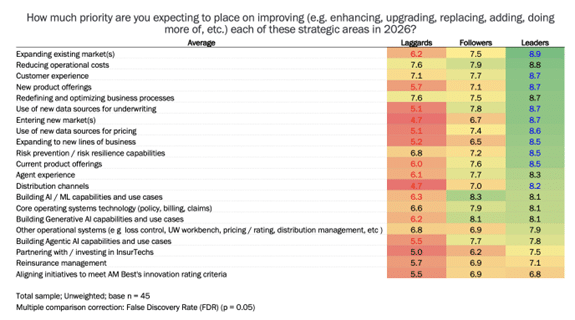
Segmenting the 2026 priorities by Leaders, Followers, and Laggards once again highlights significant gaps in ambition, readiness, and investment. Leaders rate nearly every strategic area between 8.1 and 8.9, suggesting a comprehensive strategy and enterprise-wide commitment to modernization and innovation. Their highest priorities—expanding existing markets (8.9), reducing operational costs (8.8), redefining and optimizing the business (8.7), customer experience (8.7), new data for underwriting (8.7), new products (8.7), core systems modernization (8.1), Gen AI (8.1), Agentic AI (7.8), and AI/ML (8.1)—reflect broad, balanced action to redefine the business operating model and technology foundation that will help drive new product innovation, market expansion and enhanced customer experiences that will drive real business value, growth and profitability.
Followers, while generally aligned with Leaders directionally, cluster in the mid-to-low 7s—nearly a point lower than Leaders. Their top areas of focus include AI/ML models (8.3), Gen AI (8.1), Agentic AI (7.7), Core systems (7.9), reducing operational costs (7.9), new data for underwriting (7.8), and redefining business processes (7.5), which suggest intent with less conviction or commitment that characterizes Leaders.
Even Laggards have some focus on operational change with reducing operational costs (7.6) and redefining business processes (7.6), however, the technology foundation that will enable this falls well behind with core systems (6.6), Gen AI (6.2), Agentic AI (5.3), and AI/ML (6.3), indicating that little progress can reasonably be made. In fact, overall, many scores sit in the 4–6 range, 3-4 points behind Leaders.
The gaps between Leaders and Laggards, ranging from a low of 14% to a high of 86%, represent not just differences in investment, but incompatible visions for the future.
Figure 4: 2026 strategic initiative priorities of Leaders, Followers, and Laggards
Bold Action in Practice — Following Through on What the Growth Data Shows
If the solution to business transformation in insurance could be boiled down to one word, “action” might be the best. Execution. Follow-through. Decisiveness. You get the picture. Insurers need to use the strategic priority/growth data as a spark to ignite their innovation and propel the organization into action.
Are you ready to act?
For hundreds of insurers, Majesco is the partner that guides and supports them in their journey from zero to transformed, providing a foundation to rapidly adapt and innovate.
We pioneered a core system with cloud-native and AI-native capabilities. We developed a holistic approach to managing business model change in parallel with insurance tech transformation. In a world that is changing fast, Majesco brings stability to insurance technology architectures while at the same time building insurance relationships that last decades. Contact us today and find out how Majesco is the right partner to assist with your strategic priorities now and into the future.
[i] Krivkovich, Alexis et al., “A new operating model for a new world,” McKinsey & Company, June 18, 2025, https://www.mckinsey.com/capabilities/people-and-organizational-performance/our-insights/a-new-operating-model-for-a-new-world