


Public pension systems have always operated with a long-term perspective. Their responsibility extends across generations of public employees, requiring financial discipline, administrative accuracy, and an unwavering commitment to delivering promised retirement benefits.
Today, that responsibility is becoming more complex.
Three significant forces are converging across the public retirement landscape: the accelerating development of artificial intelligence (AI), growing cybersecurity and identity threats, and the retirement of experienced professionals who hold decades of institutional knowledge.
Each represents an important challenge on its own. Together, they create a broader strategic question for public pension leaders: How can retirement organizations transform operations, protect institutional knowledge, and strengthen security without compromising the reliability and trust their members depend on?
The answer requires more than new technology. It calls for a coordinated approach to people, processes, data, and technology. Microsoft describes organizations that make this shift as Frontier Firms: they redesign how work gets done around trusted data, AI, and teams of people and AI agents working together.
Workforce Succession: Protecting the Knowledge Behind the Promise
Public pension administration is built on specialized expertise.
Calculating retirement benefits, interpreting complex plan provisions, managing service credit, processing disability retirements, and applying legislative changes require institutional knowledge that often takes years to develop.
Much of that expertise resides with experienced administrators who have spent decades navigating the complexities of public retirement programs.
As these professionals approach retirement themselves, pension systems face a growing risk of losing knowledge that may not be fully documented or easily transferred.
The challenge extends beyond replacing departing employees. Organizations must preserve the decision-making processes, historical context, and operational expertise that support accurate and consistent administration.
Modern technology can help.
Configurable business rules, automated workflows, centralized documentation, and integrated knowledge resources can help translate institutional expertise into repeatable processes. Rather than relying exclusively on individual experience, organizations can establish more consistent procedures that support both experienced administrators and incoming staff.
AI may further enhance these capabilities by helping employees locate relevant information, interpret documentation, and navigate complex administrative processes. However, technology should support institutional expertise, not attempt to replace the human judgment that public retirement administration requires. The goal is to ensure that knowledge remains accessible, processes remain consistent, and service continuity is preserved as the workforce evolves.
AI: From Emerging Technology to Practical Administrative Value
AI has generated significant interest across the retirement industry, but public pension organizations must evaluate its potential through a particularly important lens: accuracy, accountability, security, and member trust.
Unlike many commercial environments, retirement administration involves decisions that can affect an individual’s financial security for decades.
That makes responsible adoption essential.
The most promising near-term applications of AI are those that enhance operational capacity while keeping people accountable for consequential decisions.
Potential applications include:
- Knowledge management: Helping employees locate plan provisions, operating procedures, and historical documentation.
- Document processing: Classifying incoming materials, extracting information, and directing documents to the appropriate workflows.
- Member service: Assisting representatives in finding accurate information and responding to routine inquiries.
- Operational efficiency: Flagging incomplete applications, surfacing processing exceptions, and finding opportunities to reduce manual work.
- Data analysis: Supporting reporting, identifying unusual patterns, and helping administrators investigate potential inconsistencies.
These capabilities can become especially valuable as organizations work to manage increasing operational demands with evolving workforces.
Success depends on trusted data, clearly defined governance, transparent processes, and appropriate human oversight.
AI-generated recommendations must be verifiable, sensitive information must remain protected, and benefit determinations must continue to follow authorized plan rules and established approval procedures.
For public pension systems, the objective should not be to automate judgment indiscriminately. It should be to give employees better tools, more reliable information, and greater capacity to serve members. That is the Frontier Firm model in practice: AI takes on routine work, while experienced staff direct it and own the judgment.
Cybersecurity: Protecting the Digital Foundation of Retirement Administration
As retirement organizations expand digital services and introduce intelligent technologies, cybersecurity becomes even more critical. Public pension systems manage large volumes of sensitive information, including Social Security numbers, employment histories, banking details, beneficiary information, and decades of retirement records.
That information makes retirement organizations attractive targets for cybercriminals. Threats extend beyond traditional data breaches. Account takeover attempts, identity theft, fraudulent benefit changes, ransomware, and sophisticated impersonation schemes can threaten both members and institutional operations.
AI is also changing the threat landscape by making some forms of phishing, social engineering, and identity impersonation more convincing and scalable. At the same time, pension systems are under pressure to deliver convenient digital experiences, including member self-service, secure communications, online applications, and electronic benefit transactions.
The challenge is to expand access while maintaining confidence that information and payments remain protected. This requires a layered security strategy that incorporates strong identity verification, multifactor authentication, role-based access controls, encryption, continuous monitoring, and tested recovery capabilities.
It also requires governance around third-party technology providers and AI applications, including how sensitive information is accessed, processed, and retained. Cybersecurity can no longer be treated simply as an IT function. It is fundamental to operational resilience, fiduciary responsibility, and member trust.
Where the Three Challenges Converge
Although AI, cybersecurity, and workforce succession are often addressed as separate initiatives, their greatest strategic importance emerges where they intersect. Consider the retirement of an experienced benefits administrator.
That employee may possess decades of knowledge about complex plan provisions, exceptions, historical decisions, and manual processes. Without effective knowledge transfer, the organization risks losing important operational expertise.
Digital workflows and centralized information systems can help preserve that knowledge. AI-enabled tools may make it easier for newer employees to access relevant procedures and navigate complex cases.
Yet introducing these capabilities also requires careful consideration of data access, authorization, information quality, and cybersecurity controls.
A poorly governed AI implementation could expose sensitive information or introduce inaccuracies. Conversely, a well-designed approach can help organizations preserve knowledge, strengthen consistency, improve productivity, and reinforce security.
This illustrates why the three issues cannot be addressed independently.
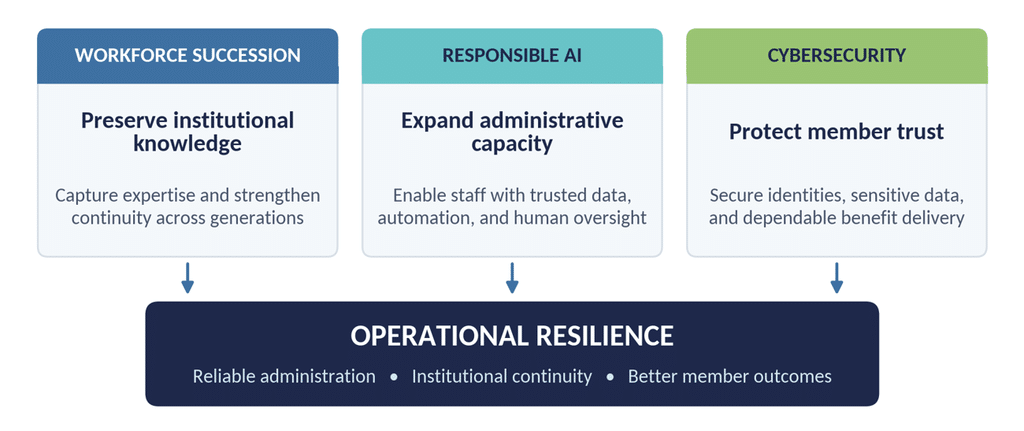
Workforce succession creates the need to preserve knowledge. AI creates new opportunities to make that knowledge accessible. Cybersecurity and governance ensure that the information remains trusted and protected.
Together, they form an important foundation for operational resilience.
Figure 1: Three interconnected pillars of public pension operational resilience.
Building a More Resilient Public Pension Organization
For public retirement leaders, the path forward begins with examining how people, processes, technology, and data work together. Five considerations can help public pension systems operate as Frontier Firms.
1. Capture institutional knowledge before it leaves. Document critical processes, complex plan provisions, administrative exceptions, and the operational expertise held by experienced employees. Make that information accessible through governed systems rather than relying on informal knowledge transfer.
2. Establish a trusted data foundation. Accurate, connected, and well-governed data supports reliable administration, better reporting, stronger security, and responsible AI adoption.
3. Prioritize AI applications with measurable operational value. Start with opportunities that reduce administrative burden, improve access to knowledge, support staff productivity, and strengthen member service. Define appropriate human oversight and evaluate outcomes before expanding adoption.
4. Integrate cybersecurity into transformation planning. Security, identity protection, access controls, and recovery capabilities should be foundational design considerations rather than additions after implementation.
5. Transform with continuity in mind. Public pension organizations cannot interrupt critical services while operations change. Phased transformation, configurable business processes, and scalable technology architectures can help systems evolve while maintaining dependable benefit delivery.
Looking Ahead: Transformation Is About More Than Technology
Public pension systems exist to fulfill commitments that span decades and generations.
Maintaining those commitments requires more than financial sustainability. It also requires organizations capable of adapting to technological change, protecting sensitive information, preserving specialized expertise, and meeting evolving member expectations.
AI, cybersecurity, and workforce succession are not isolated challenges. They are interconnected elements of a larger transformation in how public pension systems operate. Organizations that recognize those connections can transform with a clearer understanding of both the opportunities and the responsibilities involved.
The future of public pension administration will depend not simply on deploying more advanced technology but on using it thoughtfully to strengthen the people, processes, and institutional capabilities behind retirement outcomes.
The ultimate measure of transformation is not how much technology changes. It is how effectively the organization becomes more secure, resilient, and capable of serving the people who depend on it. That is what defines a Frontier Firm in public pension administration.
With Intelligent V3locity, Majesco helps public retirement and pension organizations transform administration through configurable, cloud-native technology designed to support operational efficiency, secure digital experiences, and long-term service continuity.