


Artificial intelligence, particularly generative and agentic AI, is no longer a side experiment. It is a strategic catalyst for business transformation, including a shift in operating models and technology foundations that lets organizations advance data and AI capabilities, optimize operations, build agility to respond to market changes, and speed to market with new products. This fuels growth, empowers staff, elevates customer experiences, and lowers costs.
All businesses can reap the benefits, including insurance and pension software companies, which are reshaping how products are designed and built, how markets are reached, how implementations are delivered, and how customers are supported. The nature of the AI-led shift is creating a new type of company — one that operates so decisively and forward-thinking that it has garnered its own name — the “Frontier Firm.”
The concept of the Frontier Firm began emerging in 2025 across all markets and is rapidly taking shape.[i] Frontier Firms are built around on‑demand intelligence and hybrid teams of humans plus agents. They are designed to scale more rapidly, operate more fluidly, and generate value faster than traditional organizations.
In insurance specifically, McKinsey estimates that generative AI could unlock $50–70 billion in additional industry revenue, with outsized impact in marketing, customer operations, and software engineering, areas in which software vendors are direct enablers of value creation.[ii]
At the same time, investment in insurance software and data platforms has been growing at roughly 20 percent annually, with particular emphasis on core systems that can support modular, AI‑rich architectures.[iii] Investors and insurance buyers are voting with their capital that the “digital core” of insurance, and the software providers behind it, will be central to how AI value is realized.
For core insurance and pension software companies, the message is clear. AI is now a strategic requirement and operating model imperative, not a feature checkbox. The competitive gap is set to widen quickly between AI‑centric core solution providers and those that treat AI as a peripheral add-on.
Majesco’s new Thought Leadership report, The Frontier Firm is the New AI-Centric Insurance Core Software Company,addresses three questions crucial for insurance companies selecting a core insurance software partner:
- How are leading software companies using AI to change and optimize their operating models across the value chain?
- What is different when your primary customers are insurers, and you build the core systems they run on?
- What practical blueprint can software vendors follow to become AI‑centric while delivering measurable value for insurance clients?
The pace of AI maturity, technology advancement, and innovation requires solution partners to lead the way for their customers and the industry at large, not just with AI in the core software platform, but also in their operating model. Not doing so puts software companies and their customers at risk strategically, operationally, and financially…ultimately positioning them as InsurTech Zombies.
How AI Redefines the Business Operating Model
Enterprise AI has evolved from narrow predictive models focused on isolated use cases, to broad-based machine learning applied to entire workflows, and now to generative and agentic AI that can understand natural language, reason across complex contexts, and act autonomously within and across systems. This shift has profound implications not just for those buying software, but also for software companies who develop their software to sell and run their own businesses.
A Frontier Firm represents a new paradigm of organization emerging in the age of AI. Frontier Firms are defined by Microsoft as companies “powered by intelligence on tap, run by human-agent teams, and defined by a new role for every employee: the agent boss.” They fundamentally redesign business processes around AI to achieve unprecedented agility and value creation faster than traditional companies. They invest in trustworthy data and AI foundations, forge strategic partnerships, foster an agile learning culture, integrate AI deeply into operations, and secure unwavering leadership sponsorship.[iv]
The Phases of AI Maturity for Insurers
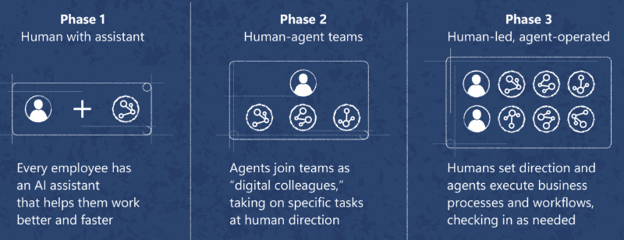
Microsoft’s 2025 Work Trend Index offers a lens for this transition. It argues that organizations are moving through three broad phases on the journey to the Frontier Firm:
- First, AI acts as an assistant that helps people do existing work faster.
- Next, AI agents begin to function as digital colleagues that take on distinct tasks.
- Finally, humans direct agents that can run broader workflows and business processes with periodic oversight rather than constant supervision.
For software companies, it is not merely a technology adoption into the software products; it is a new operating model for knowledge work and creating a new level of value to customers.
This is a redesign of work, not simply the automation of existing tasks. Each process must be challenged:
- What work remains necessary?
- What can AI perform, where human judgment adds value, and where approval is required?
Human accountability remains explicit even as agents take on more of the work. Experienced people move from repeatedly producing and transferring information to setting intent, evaluating evidence, handling exceptions, and directing outcomes.
Figure 1: Journey to the Frontier Firm (Microsoft)
Current States of Adoption
AI leaders rely on both off-the-shelf, publicly available models or tools as well as development of their own proprietary foundation models. These organizations are pulling ahead by embedding AI more deeply into their operating model and business processes with a foundational technology environment rather than simply applying AI as a generic add-on.
In its 2025 research, McKinsey reports that in nearly every sector—including insurance—the share of organizations regularly using AI in at least one business function has risen meaningfully, and that nearly 50% use AI in three or more functions. Larger companies, by both revenue and headcount, are disproportionately likely to have reached the scaling stage. This reinforces a sobering implication: companies that delay investment in scaling AI (rather than dabbling at the edge) risk structural disadvantages that become harder to close over time.[i]
The Operational and Economic Stakes for Software Vendors
The pressure to move from pilots to operating‑model transformation is especially acute in software.
McKinsey argues that for software vendors, becoming AI‑centric means much more than adding AI features to products; it means leveraging AI internally across the enterprise, from revenue‑generating functions like sales to product development, customer support and professional services.[ii]
In a survey of software leaders, a full 93 percent said that AI automation of internal operations is a top investment priority, on par with reimagining the core offerings themselves.[iii] Microsoft’s portfolio of more than 1,000 AI customer stories documents how companies are embedding Copilot and Azure OpenAI services across development, sales, HR, support, and finance to accelerate work and improve quality.[iv]
In practical terms, this shift is happening in multiple ways, including:
- Sales and marketing teams are supported by AI assistants embedded in CRM and productivity tools that identify and prioritize leads, draft tailored emails, recommend the next best action, and provide real‑time call coaching based on conversation dynamics and known customer history.[v]
- Proposal and pricing processes are being reshaped for the AI+SaaS era to align pricing more closely with customer value, usage, cost, and risk.[vi]
- Teams are beginning to use AI to analyze legacy systems, generate structured documentation, improve code modernization, and accelerate testing, significantly reducing the time and cost of complex modernization efforts.[vii]
- Software development teams are using AI‑based code assistants to improve engineering productivity and code quality.[viii]
- Support organizations are redesigning workflows around AI agents that can anticipate issues, support resolution, and handle tasks such as diagnosis, data retrieval, and summarization, with humans remaining central for supervision, empathy, and complex resolution.[ix]
Collectively, these signals point to AI as an expected element of rethinking how software companies run, not just updating the technologies in their products.
Moving decisively is an economic imperative. In its 2024 analysis, BCG highlights the unique attributes of AI adoption leaders, which include a disproportionate number of software and fintech companies. These companies showed substantially better business and financial outcomes:[x]
- Approximately 1.5 times higher revenue growth
- 1.6 times greater shareholder returns
- 1.4 times higher returns on invested capital than their peers
- 62% of AI value is generated in core business functions—operations, sales and marketing, and R&D—rather than support functions
Unfortunately, BCG estimates that roughly 75% of companies have yet to unlock value from AI at scale, often due to people‑ and process‑related barriers such as change management, product development, workflow optimization, AI talent, and governance. Deloitte’s work on enterprise AI echoes this: While many organizations have logged quantifiable productivity gains—two-thirds report improved productivity and efficiency—far fewer have translated those gains into revenue growth, deep business transformation, or lasting strategic differentiation.[xi]
Choosing AI Insurance and Pension Software Keeps Insurers and Pension Administrators Competitive
For insurers and pension administrators, selecting the right software partner is more important than ever as the window of advantage in the use of AI is narrowing. A growing number of InsurTech Zombies are unable to invest in AI development within their products and operating models. This creates significant risk for their customers.
Should they evaluate a core system provider’s AI roadmap?
Because of this, insurers and pension administrators are increasingly reexamining their core systems and technology partnerships in terms of what the vendor’s AI strategy and execution currently is, compared against what is needed today to compete tomorrow, both in terms of the products they provide but also in their operating model to provide increased customer value for implementation, support, and more.
Software vendors that can credibly demonstrate AI-embedded software and AI‑enabled operating‑model change that demonstrates business value are far more likely to be seen as strategic partners. Others risk being relegated to commodity status or even worse, becoming irrelevant.
In an industry that depends on strategic partnerships and advanced technology, given the pace of change in risk, operations, customer expectations, products, and technology, the right partner—an AI-centric core insurance software partner—will keep insurers and pension administrators competitive and help them achieve better outcomes for business models and profits.
Majesco is a Frontier Firm looking to support Frontier Firms. We are fully engaged in the AI imperative — making sure that our core systems and processes are built to turn optimized functions and costs into pressure relief for insurers and pension administrators at the same time we help them adopt AI-core systems as well. To find out even more about Frontier Firms in insurance and retirement and pension and to get a handle on the relevant steps to make your own organization a Frontier Firm, be sure to read Majesco’s Thought Leadership report, The Frontier Firm is the New AI-Centric Insurance Core Software Company and then participate in the upcoming Majesco webinar, The Frontier Insurer: From AI Experimentation to Agentic Operations.
[i] Singla, Alex, et al., 2025, op. cit.
[ii] Schneider, Jeremy, et al., “The AI‑centric imperative: Navigating the next software frontier,” McKinsey, October 16, 2025, https://www.mckinsey.com/industries/technology-media-and-telecommunications/our-insights/the-ai-centric-imperative-navigating-the-next-software-frontier
[iii] Ibid.
[iv] Taylor, Alysa, “AI-powered success—with more than 1,000 stories of customer transformation and innovation,” Microsoft, July 24, 2025, https://www.microsoft.com/en-us/microsoft-cloud/blog/2025/07/24/ai-powered-success-with-1000-stories-of-customer-transformation-and-innovation/
[v] Kelly, Greg, et al., “Agents for growth: Turning AI promise into impact,” McKinsey, November 3, 2025, https://www.mckinsey.com/capabilities/growth-marketing-and-sales/our-insights/agents-for-growth-turning-ai-promise-into-impact
[vi] Khanna, Mohit, et al., “Upgrading software business models to thrive in the AI era,” McKinsey, September 22, 2025, https://www.mckinsey.com/industries/technology-media-and-telecommunications/our-insights/upgrading-software-business-models-to-thrive-in-the-ai-era
[vii] Milinkovich, Nick, et al., “The future of AI in the insurance industry,” McKinsey, July 15, 2025, https://www.mckinsey.com/industries/financial-services/our-insights/the-future-of-ai-in-the-insurance-industry
[viii] Renner, Matt, “1,302 real-world gen AI use cases from the world’s leading organizations,” Google Cloud, April 22, 2026, https://cloud.google.com/transform/101-real-world-generative-ai-use-cases-from-industry-leaders
[ix] Kelly, Greg, et al., op. cit.
[x] BCG, 2024, op. cit.
[xi] “The State of AI in the Enterprise,” Deloitte, https://www.deloitte.com/us/en/what-we-do/capabilities/applied-artificial-intelligence/content/state-of-ai-in-the-enterprise.html