


In insurance operations and technology, transformation pays.
It only pays, however, if transformations are the result of a thoughtful approach to customer-centric strategies. Any insurer can transform internal operations and tech to streamline internal processes — and they should. But the pay-offs happen when the inside supports the outside — when transformations grow trust and confidence, produce needed products and keep premiums low and relevant.
Majesco’s thought leadership report, The Insurance Alignment Gap, directly links five enterprise transformations to customer-relevant value, helping insurers pivot their strategy to achieve the goals that foster and grow customer relationships, close the customer’s insurance coverage gap, and ultimately grow their business.
The Strategic Imperative — Turn Transformation Into Customer-Relevant Value.
Insurance is an industry of cause and effect. Linking one thing to another is an industry specialty. We see the results of specific actions, and we seek to anticipate those actions so that we become predictive, not reactionary.
So, it’s crucial that insurers stick to plan when it comes to their own transformation strategies. They should control what they can control and direct their own paths forward.
The path forward is not for insurers to choose between enterprise transformation and customer-centricity. Insurer and customer priorities are closely linked. The path forward is to connect them. (See Fig. 1 for a high-level overview.) These connections work best if insurers are building their transformation strategies on five pillars.
- Reduced internal costs should support external affordability.
- Use Data and AI not only to optimize pricing and operations, but also to identify, explain, and close customer protection gaps.
- Reframe product innovation around life stage, context, and relevance. Customer experience should be defined not only by convenience, but by confidence.
- Make every interaction simple and supportive.
- AI should be deployed not only to automate, but to educate, guide, and build trust.
This becomes the strategic imperative and real opportunity.
This does not require that insurers abandon their current strategic priorities or their business transformation. Instead, they must rethink how they shape, position and execute those priorities and transformation to create real, demonstrable customer value.
Figure 1: The path forward is to pursue both enterprise transformation and customer-centricity

How can insurers turn business transformation into customer value?
If insurers connect enterprise business transformation to customer affordability and clarity of value, they can turn a back-office agenda into a front-office advantage that will drive growth and market competitiveness.
For insurers, business transformation is driven by growth, operational costs, financial metrics, and competition. This leads them toward reducing operational costs, redefining and optimizing business processes, modernizing core systems, making customer experience improvements, innovating with new products, and building AI capabilities. These priorities reflect the growing recognition that insurers must bend the cost curve…but doing so in order to better serve customers.
If insurers can’t connect transformation into customer value, the result can be the exact opposite of what they intend to accomplish. Operational gains may improve internal economics without solving the customer’s core protection and affordability issues, leading to loss of customer loyalty, customer churn, increased expense ratios, and declining revenues.
While not every transformation initiative can be directly tied to customer value, if insurers are willing to ask the question, “How does this effort lead to better value for our customers?” they will frequently be able to justify and quantify their efforts.
How does insurer transformation affect insurance affordability in practice?
The logic here may seem like a no-brainer. When insurers reduce their expense ratios and loss ratios, they can reprice products that will reduce premiums. Insurers must be careful as they look at the costs that influence these financial ratios to foundationally change the cost structure rather than a quick price reduction to ensure sustainable and affordable insurance premiums.
Here is where we can first look at the idea of customer preparedness in relation to insurance transformation. Can insurers use transformations to make customers feel and be more prepared?
Majesco customer data shows that when they have the right products and services, preparedness lifts materially, often by 30-40%. Specifically, for financial risk, older customers gain significant preparedness lifts from structured long-term products such as 401(k)s, IRAs, annuities, and health-related protections, while younger customers feel prepared with bounded and specific financial protections such as long-term care insurance for oneself, college savings plans, and final expense coverage.
Majesco identified four insurance capabilities that can contribute to customer preparedness: Data, Pricing, Product design and Operating Model. Each of these can be directly or indirectly tied to meeting customer financial vulnerabilities.
Figure 2: Translating insurer strategic capabilities into customer financial resilience

How can insurers help customers prepare for risk?
Product relevance and improved, tailored communication should be among the highest strategic priorities for insurers.
Customers are looking for help navigating uncertainty, not just policies that respond after something goes wrong. Insurers who reposition themselves as partners in preparedness—through better product design, clearer communication, and proactive services—have an opportunity to close protection gaps, strengthen long-term relationships, and drive profitable growth.
When it comes to innovative product development, Majesco research suggests that the real issue is not product scarcity; it is product relevance.
Among insurers, there is troubling stagnation in market-related and product-related activities. Many insurers are clustered between considering and planning/piloting in areas that should be central to empowering customer preparedness, let alone future growth. Product development in newer and emerging categories such as embedded, usage-based, IoT/telematics-based, and worksite or individual offerings in benefit plans remain flat or declining, even as the market itself moves in those directions.
It is like two ships sailing past each other.
The customer viewpoint highlights the other side of that problem. Customers reveal that while the right products and services can materially improve preparedness, adoption remains uneven and highly dependent on life stage, timing, awareness, and perceived relevance. Latent demand exists across many categories, particularly when products are framed in terms of real risks and meaningful outcomes rather than abstract coverage categories.
This convergence is highly significant.
Insurers often see innovation as costly, uncertain, and hard to deliver, especially in legacy environments. Customers, however, value innovation when it is useful, timely, and easy to understand. The challenge is not creating more products but designing and positioning products that address real protection gaps.
Figure 3: Insurer innovation efforts should focus on product relevance to customer needs

The strongest and most successful product strategies in the next era will be those that move beyond traditional product portfolio logic toward broader solution logic.
That means packaging products, services, guidance, and ongoing engagement around life-stage risks, financial vulnerabilities, and prevention opportunities. It requires expanding options in newer product categories, such as parametric, embedded, and usage-based insurance; offerings that are more visible and easier to understand as a bridge to preparedness.
How should insurers use AI to deliver visible customer value?
AI is a strategic enabler. Its breadth of use is so universal that it has become ubiquitous. To say you are using “AI” now can mean anything.
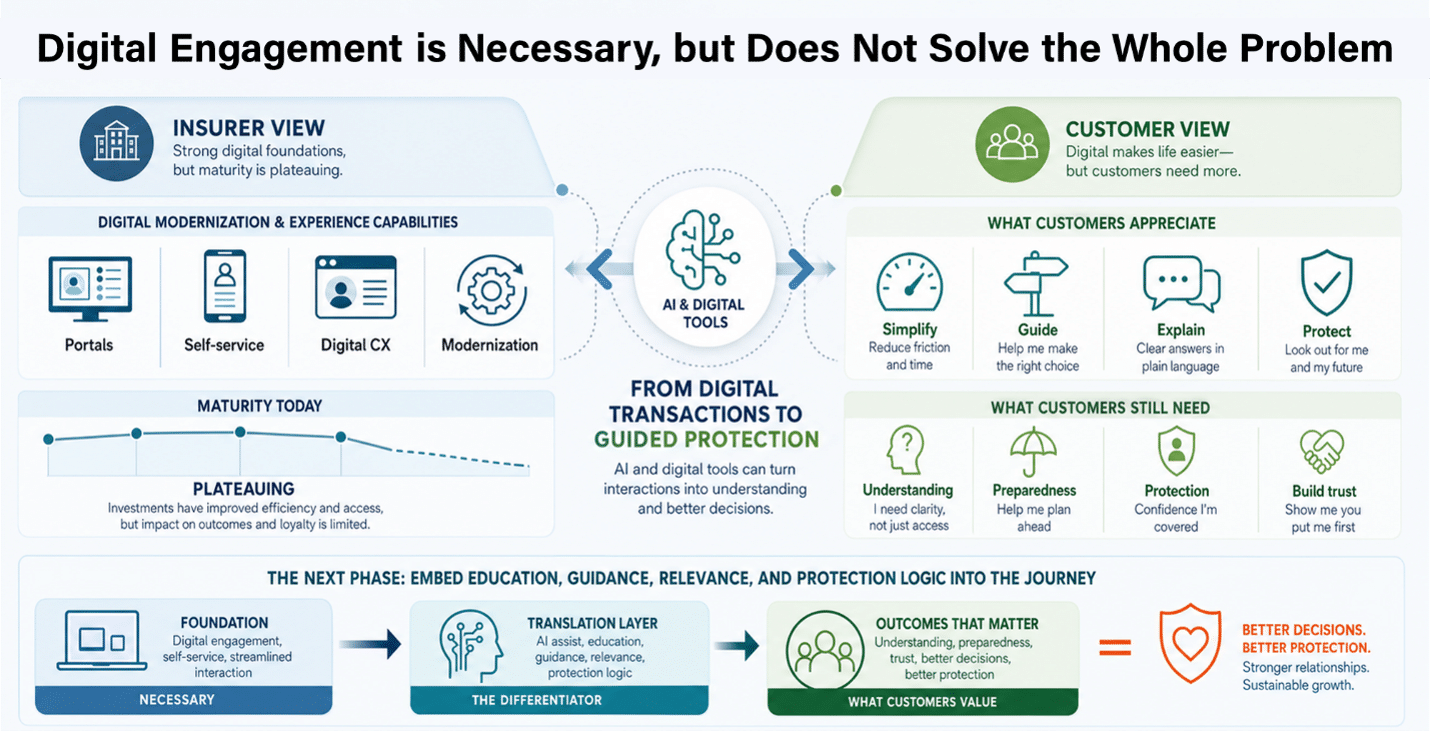
But for customer purposes, insurers need to focus on using AI in a holistic transformation of digital engagement that leads to guided protection. This means that they will redesign customer products, services and engagement journeys around education and preparedness, not just purchasing.
It may require positioning insurance as part of a broader financial resilience strategy rather than a standalone transaction. It may require new language, new measures, and new ways of defining value.
Customers increasingly appreciate AI-assisted and digitally enabled interactions, especially when they simplify complexity and reduce friction. Yet the research makes clear that the core gaps are not about interaction design; they are about understanding, protection, preparedness, and trust. It’s the wealth of information behind the interaction that is of real customer value — which can be enhanced by the use of AI.
Figure 4: Digital experience must focus on helping customers make better decisions and feel more protected
Can insurance transformations help to close the protection gaps that still exist?
Protection gaps represent more than unmet coverage needs; they reflect unmet emotional and practical needs. Customers are looking for help navigating uncertainty, not just policies that respond after something goes wrong. Insurers who reposition themselves as partners in preparedness—through better product design, clearer communication, and proactive services—have an opportunity to close these gaps, strengthen long-term relationships, and drive profitable growth.
As this research shows, the insurance industry is entering a period in which strategy and customer reality can no longer evolve on separate tracks.
For customers, success will be defined by insurers helping them be more prepared, protected, and confident in a world of rising uncertainty, financial strain and cost.
For insurers, success in the next era will require modernization of the operational model and technology foundation with stronger strategic execution.
Successful insurance leaders will address both together, rather than as separate mandates—recognizing they are the same mandate, seen from different sides. As a result, they will close the alignment gap between what the business enterprise needs to become and what the customer needs it to be.
Are you ready to align your transformation priorities to the priorities of your customers — and get the results that you both need? Contact Majesco today. And be sure to read, The Insurance Alignment Gap: Where Insurer Priorities and Customer Protection Needs Converge…and Diverge.