


You are shopping for a new refrigerator. How do you choose? One is the right size from a durable brand but lacks features. Another is a little larger, but it comes with a touch screen and speakers. It tells you when it needs a water filter, then it shows you how to replace it. It is far more expensive, but maybe less reliable. At the end of the day, what you really care about is that your food stays cold and doesn’t go bad. Which do you choose?
From the manufacturer’s perspective, high-tech refrigerators require complex motherboards, regular software updates, and technician training. On the plus side, they sell well. They meet the needs of the digital customer. They are profitable. New technologies are helping to predict and prevent breakdowns. Manufacturers could scale back and sell only the simple machines, but that road leads to lower market share. Common sense says that to grow requires alignment with market demand and expectations.
Insurers and customers — how do they align to meet needs and goals?
When it comes to life (and insurance), customers are strained with similar decisions — cost being one of them. When it comes to business (and creating, selling and administering insurance), insurers are strained by their need to transform to meet customer needs. Clearly their stressors are different and unique, but patterns exist that hint at solutions for both groups. Insurance companies and insurance customers are impacted by the same pressures, but are reacting to them differently, creating an alignment gap.
The solution begins with insurers willing to recreate transformation agendas around what customers need.
For insurers, the dominant themes are operational cost, profitability, replacing legacy core technology, expanding risk, and the need to use AI to create a more intelligent operating model and enhanced customer experience. For customers, the dominant themes are affordability, financial vulnerability, preparedness, protection gaps, trust, and whether insurance actually feels relevant to the risks they face in everyday life.
While the two perspectives are different, they are not totally disconnected. In fact, they are often looking at the same problem from opposite perspectives. That is the central finding of Majesco’s recent Thought Leadership report, The Insurance Alignment Gap: Where Insurer Priorities and Customer Protection Needs Converge…and Diverge, where we took the survey results from Majesco’s primary research with insurers and customers and assessed the similarities, differences and patterns between them.
There is a meaningful pattern of alignment around cost pressure, financial strain, product relevance, managing risk, personalization, digital engagement, AI, and the need for a more proactive and protective insurance model. Yet there are critical disconnects in emphasis, language, and urgency.
- Insurers often frame the issue from an inside perspective—through the lens of enterprise business transformation and financial metrics.
- Customers frame it from an outside perspective—through lived experience and affordability.
- Insurers prioritize modernization to improve operational efficiency, products, and competitiveness.
- Customers want solutions that improve confidence, protection and preparedness, affordability, and trust.
A Market Under Pressure from Both Ends
Insurers are clear that cost pressure, profitability, expense ratios, growth, legacy technology, replacing legacy core, and AI-enabled operating change are top-of-mind issues and strategic priorities. But the industry is heavily constrained by outdated operating models and legacy technology foundations that are limiting growth, productivity, driving up expenses, slowing innovation, impacting customer loyalty and value, and inhibiting adoption of AI.
For insurance customers, the pressure is just as real, but much more personal. Customers are dealing with rising financial strain, protection gaps, increased risk, and a widening disconnect between the risks they care about and how prepared or protected they feel to manage them. In particular, financial risks are the most acute area of under-protection. As insurance costs rise, customers are forced into difficult decisions:
- Do we even need insurance?
- Do we need our coverage at a lower cost? (And do we need to switch insurers?)
- Do we need to increase our deductibles?
The results of these decisions often deepen the protection gap and erode loyalty and trust.
Together, these viewpoints tell a compelling story.
- Insurers are under pressure to become more efficient, intelligent, adaptable and relevant — but often prioritize decisions to reduce internal operational costs.
- Customers are under pressure to become more financially resilient, protected, and confident — but often find themselves going in the opposite direction for cost.
While both sides are responding to the same environment of economic strain, risk volatility, and rising expectations, they are each fixing different things: one the operating model, and the other trying to make life work. Majesco’s report looks at alignment priorities across several common themes, including three that we will examine here:
- Cost pressure
- Financial risk
- Customer experience
Cost Pressure
Shared context, not shared experience
If there is one theme that defines both segments, it is cost pressure.
For insurers, cost pressure is a business operating model problem. It is reflected in the highest 2026 strategic initiative priorities including: reducing operational costs, redefining and optimizing business processes, core systems modernization, customer experience, and building AI capabilities. Insurers must dramatically change the cost curve, but doing so requires more than isolated tactics. It demands a rethinking of the operating model, workflows, technology foundation, and data quality and access.
For customers, cost pressure is a household survival issue. Rising insurance costs, inflation, healthcare expenses, and financial insecurity create a direct sense of vulnerability that shapes what and how people buy, drop, postpone, or re-evaluate protection. It is not about expense ratios or operating leverage. It is about whether protection is affordable enough to keep, valuable enough to justify, and relevant enough to prioritize over other financial demands.
This is an important distinction. Why?
It changes the meaning of transformation.
While insurers’ focus is operational efficiency tied to profitability and competitiveness, it must go broader to consider how it creates more affordable, accessible, understandable, and valuable insurance protection products and services. This is a major alignment opportunity.
Figure 1: Shared cost concerns experienced differently
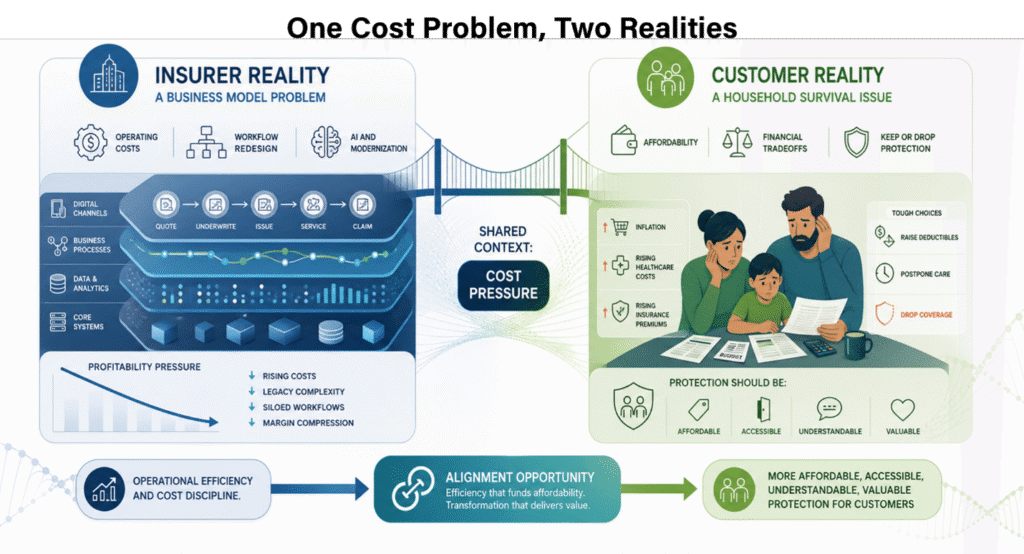
If insurers connect enterprise business operational transformation to customer affordability and clarity of value, they can turn a back-office agenda into a front-office advantage that will drive growth and market competitiveness.
In contrast, if insurers do not, operational gains may improve internal economics without solving the customer’s core protection and affordability problem, leading to loss of customer loyalty, customer churn, increased expense ratios, and declining revenues.
Financial Risk
Where the Alignment Gap Becomes Most Visible
The customer research makes one point unmistakably clear: financial risks represent the largest protection gaps across generational groups.
This is not a niche issue.
There is a broad and persistent gap between concern and preparedness in areas such as inflation, retirement, healthcare costs, and emergency savings. Customers understand these risks. What they lack is confidence that they are adequately protected against them.
In contrast, insurers frame financial risks and priorities through the lens of enterprise performance: profitability, growth, underwriting, pricing, expense ratios, and business model redesign. These are not the same as the customer’s concerns, but they are closely related. Better underwriting and pricing, along with managing claims expenses with a competitive product portfolio and efficient operating model, influence how insurers can serve customer financial protection needs cost-effectively.
Insurers focus on company financial outcomes while customers focus on financial risk at the household level.
Insurers focus on profit and growth. Customers focus on financial resilience. Insurers look at loss ratios, expense ratios, profitability, and modernization return. Customers look at whether they can withstand a catastrophic weather event, health event, a retirement shortfall, a funeral expense, or increased living costs.
The Opportunity:
The strongest bridge between insurer strategy and customer need may not be “insurance products” in the traditional sense but meeting the demands of broader financial resilience.
When customers have the right products and services, preparedness lifts materially, often by 30-40%. Specifically, for financial risk, older customers gain significant preparedness lifts from structured long-term products such as 401(k)s, IRAs, annuities, and health-related protections, while younger customers feel prepared with bounded and specific financial protections such as long-term care insurance for oneself, college savings plans, and final expense coverage.
Figure 2: Translating insurer strategic capabilities into customer financial resilience
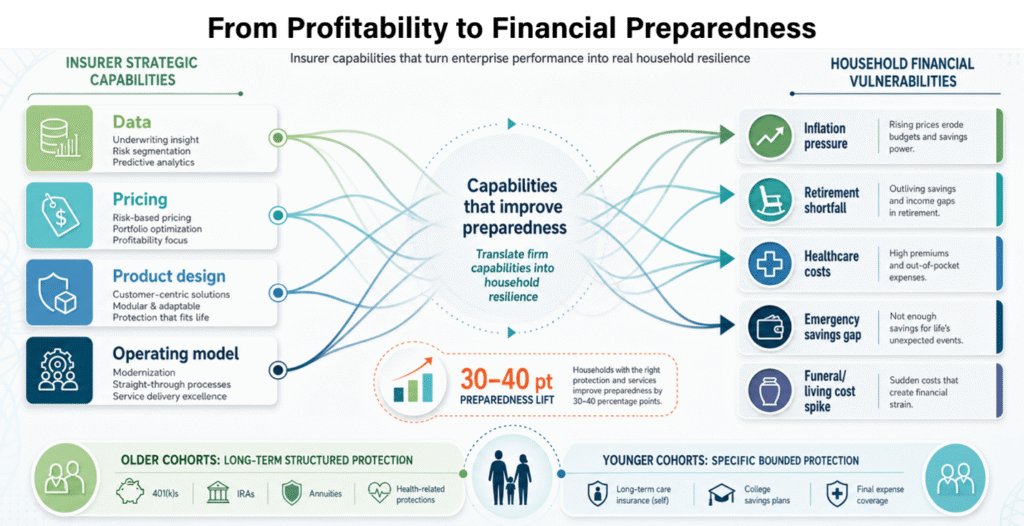
These insights highlight a broader role insurers can play to connect protection to financial resiliency, confidence, and life stage timing. Insurers’ opportunity can expand from providing insurance coverage to one that helps manage financial resiliency, with protection, risk avoidance, and financial growth options. Doing this, insurers will create a more relevant and visible role in helping customers manage a world of financial uncertainty. This will create trust and loyalty.
Customer Experience
CX Matters to Both, But it Means Different Things
Insurers and customers define experience very differently, which sets up another misalignment.
Insurers put customer experience as a highly-ranked strategic initiative. Leaders are using intelligent core systems, self-service, proactive communication, AI, and data-driven personalization to continue to enhance the experience. They have a digital transformation strategy, but not a business transformation strategy. Research shows stagnation or decline in some customer experience categories, suggesting current investments are insufficient or not focused on the full business experience.
For customers, experience is much broader than digital convenience. Experience includes protection relevance, product understanding, clear communication, affordability, personalization, and feeling more prepared rather than simply more covered. Customers evaluate experience well beyond portal usability and responsiveness.
Customers evaluate experience through confidence, clarity, and value.
A 2026 JD Power study focused on auto insurance backs this up, highlighting that while auto insurance prices declined and satisfaction on price improved, carriers are losing ground on a different front: the customer experience.[i] The study’s central finding is about friction, rather than price. A seamless cross-channel experience is now the single most impactful driver of satisfaction.
Customers are using multiple channels. (Half of customers, 46%, used more than one interaction channel in the past 12 months.) Multi-channel availability is great, but having to use multiple channels to resolve a single inquiry is annoying. Some 21% of customers reported this experience, and those who did were significantly less likely to renew. Agents resolve 91% of cross-channel inquiries once engaged. The website resolves just 66%. Insurers need to address where and why resolutions break down.
This is why these two viewpoints are so complementary.
Customer experience is well beyond the user interface. It is now a confidence issue. A customer can access a great digital self-service portal, but still feel under-protected, overwhelmed, or unconvinced…ultimately failing to build trust. Insurers need to see their way around transactions and include all of the pressures that customers are also feeling around protection and need.
Figure 3: Customer experience is now a customer confidence issue
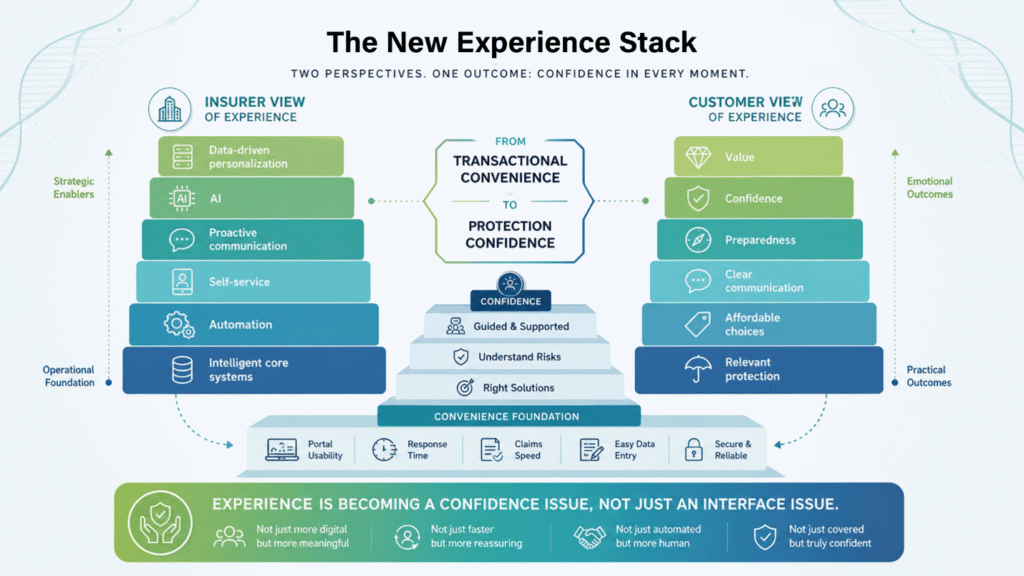
Customer experience strategy must evolve from transactional convenience to protection and resiliency confidence.
Faster interactions matter. Easier data entry matters. Better self-service matters. But they matter most when they help customers understand risks, choose relevant solutions, and feel the insurer is an active partner rather than a distant processor. It is about the broader financial and protective relationship.
How do cloud-native and AI-modernized core systems improve the customer experience?
Insurers most likely to outperform in the years ahead will be those that connect internal business transformation agendas directly to external customer outcomes. Much of this can and will be accomplished through improved relationships built by personalized service and the sense of preparedness that customers crave. Cloud-native and AI-modernized core systems will address the communication and preparedness links needed between insurers and customers.
Personalization and preparedness
For customers, personalization is less about precision and more about relevance. They respond to solutions that align with their life stage, immediate needs or concerns, perceived exposure, and current financial reality. Preparedness and adoption are strongly shaped by timing, context, and perceived helpfulness and value.
These are ALL details that will involve AI-modernized core systems for data collection, analysis and communication. Modern insurance core systems will address:
- Insurer operational cost reduction
- Customer affordability
- Customer understanding of risk and choice navigation
- Customer confidence
- Insurer product innovation — designing offerings that are relevant to the realities of customers’ lives, financial pressures, and evolving exposures.
The future of insurance leaders will be shaped by insurers who modernize with AI and Cloud-native platforms and translate that modernization into customer value. For a deeper look at how the alignment gap should reshape insurer strategy, sign up for Majesco’s upcoming webinar, The Insurance Alignment Gap: How Insurers Can Turn Business Transformation into Customer-Relevant Value.
[i] Rosanes, Mark, “Auto insurers face a new problem: it isn’t price,” Insurance Business, June 9, 2026, https://www.insurancebusinessmag.com/us/news/auto-motor/auto-insurers-face-a-new-problem-it-isnt-price-578262.aspx