


It has been said that the best advertisement for insurance is not having it (or not having enough of it) when it is needed. We see these heart-sick moments playing out.
- The small business owner of a popular beauty salon did not have enough or the right coverages for a recent 100-year weather event, closing her business for repairs. She is not sure she will be able to reopen.
- Byron, a 35-year-old physical therapy practitioner, is enrolling in his benefits plan. The cost of the medical insurance is limiting what he can further afford for other insurance, creating a gap in protection.
- Rita, an elderly parent, has very little money, but requires full-time care — forcing her children to make difficult and stressful decisions. No one thought to consider long-term care.
- The Navarro family loses their home in a wildfire, and they didn’t know that because of inflation, restoration costs would far exceed what their coverage was.
What makes the stories more profound is that in most cases, people aren’t negligent in getting coverage — they are simply unaware of the changing risk profile around them and the need for increased or additional coverages. Too often they are reacting to financial pressures they don’t control, often limiting what they buy. The result is a growing protection gap.
Rising Premiums and Limited Financial Means are Growing the Protection Gap
Risk is often cyclical. It can gain momentum as it rolls forward. An increased risk environment, exacerbated by inflation and repair costs, is causing insurance costs to rise and, therefore, premiums to rise. Customers may choose not to purchase insurance, switch for lower cost or increase their deductibles.
Risk is also hidden. People don’t always know what they are going to encounter. The combination of uncertainty and increased insurance premiums across nearly all lines of business is unsustainable for customers.
The result is a growing insurance protection gap in the industry.
Majesco recently looked at lifestyle risks, financial risks, and safety and security risks to see how the gaps are created, sustained and growing. We looked at Gen Z and Millennial buyer insurance trends vs. Gen X and Boomer trends to see which generational groups have prioritized preparedness and which ones have opted to “live with” the risks instead of prioritizing them. Which generations are most likely to go without coverage? We outlined customer sentiment in a recent thought-leadership report, Closing the Insurance Customer Protection Gap: How Generational Differences in Risk, Readiness, and Coverage are Redefining Insurance Value.
In the report, Majesco also identifies learning opportunities for insurers.
- How can insurers address protection gaps through system transformation?
- How can new products and services reverse the trends and help more people protect themselves against growing risks?
Majesco’s research highlights five defining insights that reveal both the depth of today’s protection gaps and the strategic growth opportunity they represent for insurers:
- Financial Risks Are the Epicenter of the Protection Gap.
Across generational groups, financial risks—especially inflation, healthcare costs, retirement security, replacement costs, and emergency savings—show the largest and most persistent gaps between concern and preparedness, often exceeding 20%. This isn’t a niche issue; it reflects structural financial vulnerability that traditional insurance alone has not solved. - Protection Risk Importance Without Preparedness Creates Anxiety—and Opportunity.
Customers understand what matters most — health, family security, home and auto protection, financial stability—but consistently feel underprepared. These protection gaps are emotional as well as financial, creating a trust fault line that insurers can either ignore—or strategically address. - Products Work—Adoption Is the Real Problem.
When customers have the right products, perceived preparedness lifts dramatically—often by 30–40 percentage points. The challenge is not skepticism about value, but misalignment, timing, and relevance that limit adoption and engagement. But adoption could also be addressed through embedded insurance, which perhaps hasn’t reached optimal utilization. - Safety Risk Is Strong, But Digital Risk Is the New Vulnerability—and Opportunity.
Traditional property and auto protections are well embedded, producing relatively small gaps. However, cyber risk and identity theft—particularly among Gen X & Boomers—represent emerging weak spots where concern materially outpaces confidence. - AI Is Emerging as the Bridge Between Concern and Action.
Customers—especially younger cohorts—are increasingly open to AI in insurance interactions. Used strategically, AI can personalize risk education, simplify decisions, and guide adoption—transforming insurance from a reactive product into a proactive preparedness partnership.
The Big Picture: Financial Risks Drive the Largest Protection Gaps
Based on the survey data (see Figure 1), when protection gaps are aggregated across risk categories, financial risks clearly dominate. For both generational cohorts, the gap between concern and preparedness for financial risks is much larger than for lifestyle or safety/security risks.
This heightened focus reflects the compounding pressures of inflation, healthcare costs, replacement costs, retirement uncertainty, and limited emergency savings—all of which are top-of-mind for customers but inadequately addressed by their current financial and insurance arrangements.
Figure 1: Overall protection gaps by risk category
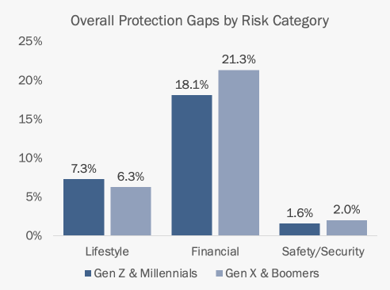
By contrast, safety and security risks show relatively small aggregate gaps, suggesting that traditional insurance products have been more effective in helping customers feel protected. However, this topline strength masks meaningful gaps within specific risks and segments, particularly for newer or more complex threats.
Together, these risks shape a roadmap for understanding and assessing customers’ risk profiles and how insurers can address their protection gaps more holistically over customers’ life stages, creating trust and loyalty along the way.
Lifestyle Risks: High Importance Does Not Mean Adequate Protection
Across both generational groups, lifestyle risks are rated highly important, with scores clustering between 3.7 and 4.6 on a five-point scale, where 5 is very important as seen in Figure 2.
The most important issue is maintaining good personal health for both Gen Z & Millennials (4.5) and Gen X & Boomers (4.6), yet both cohorts report lower preparedness (4.0 and 4.1, respectively), resulting in identical 11% protection gaps. While not large, one health calamity can create significant financial and personal risk.
Similarly, caring for aging or disabled parents and relatives produces one of the more pronounced generational differences: while importance is strong for both, Gen X & Boomers report a larger 12% gap compared to 9% for younger customers—reflecting heightened exposure and responsibility among older households.
Finally, international travel reveals a meaningful gap, particularly among Gen Z & Millennials (10% vs. 5%), suggesting greater perceived vulnerability tied to global mobility.
By contrast, event-driven lifestyle risks such as attending concerts or sports events and upcoming weddings show minimal gaps, and in some cases near alignment between importance and preparation—especially among Gen X & Boomers. Domestic travel and pet care sit in the middle, with moderate importance and mid-single-digit gaps for both generations.
Figure 2: Lifestyle protection gaps
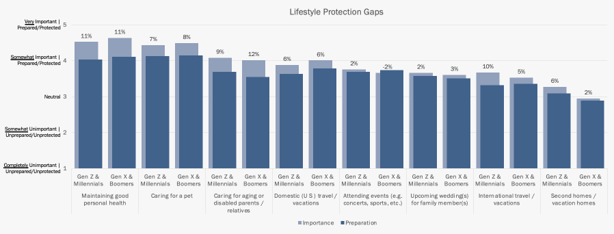
Overall, the data suggests that the largest lifestyle protection gaps emerge where risks are ongoing, health-related, or caregiving-intensive, rather than episodic or discretionary, highlighting areas where customers feel meaningfully exposed despite relatively strong baseline preparedness.
This suggests an opportunity for insurers to develop and offer new products or services that can enhance the protection of current, traditional products.
Financial Risks: The Core Protection Gap Crisis
Insurance is often misunderstood as an unpopular expense, but in reality, it is a critical component of a robust financial strategy. At its core, insurance is a risk management tool designed to protect customers from potential financial devastation. Financial planning is essentially about creating security and predictability in an inherently unpredictable world. Insurance serves as a critical mechanism to transfer risk from individuals and businesses to insurers who are focused on assessing, managing and mitigating their financial risk.
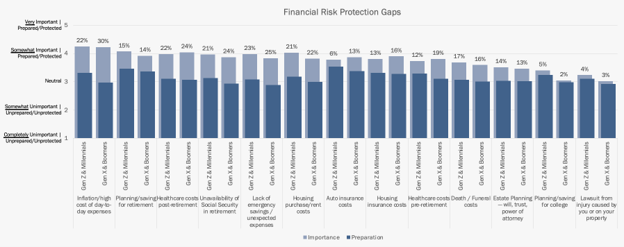
In this research, financial risks produce the largest and most consistent protection gaps, with several categories exceeding 20% for both generations, as seen in Figure 3.
At the top, inflation and the high cost of day-to-day expenses emerge as the single largest gap overall—22% for Gen Z & Millennials and a striking 30% for Gen X & Boomers—with equally high importance ratings (4.2).
Similarly elevated gaps appear for healthcare costs in post-retirement (22% and 24%), lack of emergency savings (23% and 25%), housing purchase or rent costs (21% and 22%), and concerns about the unavailability of Social Security (21% and 24%). In each case, importance ratings cluster around 4.0, while preparedness lags significantly behind, revealing widespread structural financial vulnerability rather than isolated pressure points.
Figure 3: Financial risk protection gaps
Generational differences are evident in both intensity and context.
Gen X & Boomers consistently report slightly lower preparedness levels, resulting in larger gaps in inflation, emergency savings, Social Security, pre-retirement healthcare, and housing insurance costs. Gen Z & Millennials, while also facing substantial financial gaps, show comparatively smaller differentials in retirement planning and insurance-related costs. This may reflect their focus on alternative investment options to cover the lack of Social Security.
By contrast, risks such as planning for college and liability exposure show relatively small gaps across both segments, suggesting greater perceived manageability or clearer existing solutions.
Overall, the data underscores that financial protection gaps are broad-based, deep, and persistent, driven not by lack of awareness, but by customers’ recognition that their current financial options, tools and savings levels are insufficient to match the scale of today’s economic risks. Once again, this highlights a major opportunity for insurers to develop new products and services to address these financial risk gaps.
A broader financial assessment and planning across all these risks is needed to truly understand, mitigate and manage customers’ risk as their lives evolve. As a result, insurers will be able to identify new products and services that can meet the range of needs to close these protection gaps.
Safety & Security Risks: A Traditional Strength—with Emerging Vulnerabilities
Compared to lifestyle and financial risks, safety and security risks reflect relatively small protection gaps overall, highlighting stronger baseline preparedness.
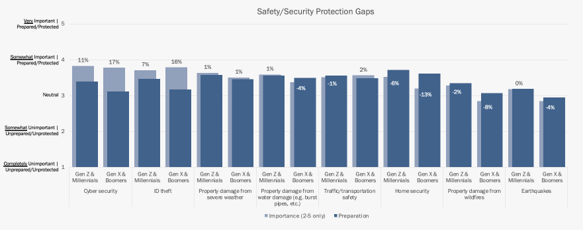
For both generations, importance and preparation ratings for property damage from severe weather and water damage are closely aligned, creating minimal gaps. In several cases—particularly among Gen X & Boomers—confidence even exceeds concern. Home security (-13%), wildfire damage (-8%), and earthquake risk (-4%) all show negative gaps for older customers, suggesting they feel well protected relative to the level of risk they perceive. Gen Z & Millennials show similar patterns, with small or negative gaps for traffic safety, home security, wildfires, and earthquakes.
The most meaningful protection gaps are concentrated in digital risks, particularly cybersecurity and identity theft. While both generations rate these risks as important (3.7, 3.8), preparedness lags—most notably among Gen X & Boomers, who report a 17% gap for cybersecurity and a 16% gap for ID theft, compared to 11% and 7% respectively for younger customers.
Figure 4: Safety and security risks protection gaps
Identity theft is a universal concern, but each generation’s exposure and threats differ based on lifestyle and digital use. As an example, Gen Z must learn to limit digital exposure, particularly on social media. Millennials need stronger digital hygiene in work-life balance—with many now working from home, Gen X needs to prioritize regular financial monitoring. And Boomers require ongoing education to spot scams.
These findings indicate that traditional property and physical safety protections are well embedded, but growing digital and data-related exposures represent a more persistent vulnerability—especially for older households.
Overall, safety and security protection appears strong at the foundation, but emerging digital risks that can significantly harm people’s finances offer targeted opportunities in cyber resilience and identity protection products and services that align to generational use and risk. As part of a product or service, risk prevention education and ongoing assessments should be considered, given the rapidly changing world of digital risk.
Insurer Opportunities
1. Insurers need to understand customers and their risks and preferences at an individual or business level at a granular level.
2. They must feed that understanding back to customers, with recommendations, through comprehensive and targeted communication efforts that encompass agents, adjusters, as well as direct e-mails and texts. This is more than marketing. It is preventive — insurers participating in lifestyle, cyber, financial and health monitoring and improvement.
3. Insurers should use AI’s ability to flag those who may be more concerned, those who may be at real risk and those who need to understand a bit more about the gaps they may have that they don’t recognize.
4. Insurers MUST better prepare themselves for risk by advancing their systems, processes and business models to a new level of modernization. This would include intelligent core insurance platforms and AI-enabled experiences using Immersive, Agentic AI and GenAI to automate workflows and improve decision-making.
Are you ready to reverse the growing protection gap by meeting customer needs across all generations? Contact Majesco today! You can also learn more by viewing one of our recent webinars, The Insurance Alignment Gap: How Insurers Can Turn Business Transformation into Customer-Relevant Value.