


The case for innovative insurance products
How many cell phones have you owned? Computers? Cars? Appliances? Televisions? Do you still have your original cell phone, computer, car or television? Unless you are very young, it is unlikely. We move on to new models and sometimes products become obsolete. Sometimes we want something a little nicer. Or on occasion, we seek that little kick of satisfaction that comes with knowing a new thing does something new.
To those outside the insurance industry, it may seem strange to call insurance policies “products.” They aren’t tangible or visible. But by most other criteria, an insurance product relates to life and lifestyle in ways that are very product-like, and therefore, need to be marketed like products.
In the same way that traditional manufacturers update their models, insurers must also become innovative. Insurers need to remain relevant and appealing. They must meet new needs and risks with innovative insurance products to meet those risks — knowing that in some cases, people need a new product that does something new.
What insurance products would make customers feel most prepared?
Majesco recently surveyed insurance customers to analyze how product availability stacks up against customer sentiment regarding protection and preparedness. We reported their responses about a wide variety of insurance products and services in our recent Thought Leadership report, Closing the Insurance Customer Protection Gap: How Generational Differences in Risk, Readiness, and Coverage Are Redefining Insurance Value.
What did we find out? Among respondents who do not currently have certain insurance products, many believe that they would improve their sense of protection, especially in financial and health-related areas, but also in security-focused areas, such as cybersecurity and ID theft. Primarily, what we learned was that there is a gap between what customers need today and the products they have, know about or need. These gaps are areas of opportunity for insurers to launch new products or services, capture or retain customer and grow revenue.
Proof of Value: Products That Close the Protection Gap
Majesco’s research data shows that products and services work well and meet customers’ protection needs when they buy them, meeting the foundational goal of insurance.
Across three different risk categories, respondents who use relevant products consistently report higher levels of preparedness as compared to those who do not. In some cases, the lift in perceived protection exceeds a strong 30–40 percentage points.
These implicit lifts validate the core premise of insurance and related services: the challenge is not customer skepticism about value, but limited reach, understanding, right products, and adoption.
When products are aligned with real needs, they meaningfully reduce anxiety, reduce risk, and increase confidence. And it strengthens insurer relationships, making them the go-to for future needs.
What do the generations perceive as important for preparedness?
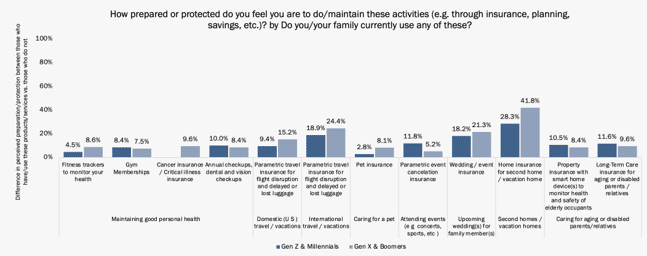
Having the right lifestyle-related products materially increases customers’ sense of preparedness—but the magnitude of that impact varies widely by product and life stage.
The strongest lifts occur for products tied to high-stakes, infrequent, or asset-intensive lifestyle risks, particularly among Gen X & Boomers. Insurance for second homes, for example, delivers the largest perceived benefit across both generations, with a 41.8% lift among Gen X & Boomers and a still-substantial 28.3% lift among Gen Z & Millennials.
Similarly, wedding and event insurance and parametric travel insurance—especially for international travel—produce strong gains in perceived protection, reinforcing the value of clear, event-based coverage where financial exposure is concentrated, and outcomes are binary.
Generational differences reveal how context shapes perceived value. Gen X & Boomers experience consistently higher lifts from insurance-based health and travel protections, including cancer or critical illness insurance (9.6% lift vs. –0.4% for the younger generation), pet insurance, and parametric travel insurance. This suggests that the older generation more readily translates coverage into confidence, particularly for risks with potentially severe financial consequences.
Gen Z & Millennials, by contrast, show relatively stronger lifts from products that align with experiential, technology-enabled, or caregiving-adjacent needs, such as parametric event cancellation insurance (11.8% vs. 5.2%) and smart-home-enabled protection for aging relatives.
Figure 1: Lifestyle preparedness/protection lifts from products/services used
Financial risk preparedness/protection lifts
Financial protection products deliver some of the largest gains in perceived preparedness—but those gains are highly segmented by life stage and product complexity.
For Gen X & Boomers protection lifts:
- Traditional long-term financial instruments generate the strongest impact.
- Investments such as 401(k)s and IRAs drive a substantial 37% lift in retirement preparedness and a 19% lift in confidence around Social Security availability.
- Retirement annuities deliver additional double-digit gains.
- Health insurance and Medicare-related products stand out for this cohort, with a 33% lift in preparedness for pre-retirement healthcare costs and measurable gains for post-retirement medical coverage.
These results underscore that older customers translate structured, long-horizon financial products into confidence more readily—particularly when risks are imminent.
Gen Z & Millennials protection lifts:
- Long-term care insurance for oneself (33% )
- College savings plans (27%)
- Funeral or final expense insurance (21%).
Figure 2: Financial risk preparedness/protection lifts from products/services used
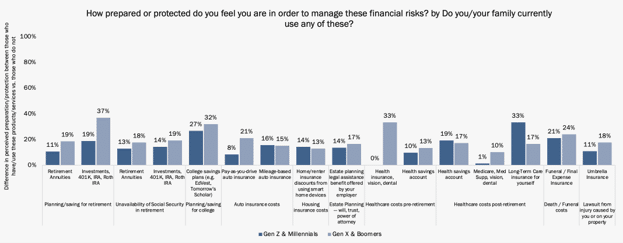
Usage-based auto insurance and smart-home–related insurance discounts produce modest but meaningful lifts, signaling sensitivity to cost control and near-term financial tradeoffs.
Safety & security risk preparedness and protection lifts
Safety and security products meaningfully increase customers’ sense of protection, with the strongest gains concentrated among Gen X & Boomers and in property- and disaster-related risks. Traditional coverage, such as homeowners or renters insurance, delivers a substantial lift for older customers (25% vs. 7% for Gen Z & Millennials). They gain confidence from asset protection.
Parametric products lift tied to severe weather, flooding, wildfires, and earthquakes generate consistently higher lifts among Gen X & Boomers, peaking at a 40% lift for parametric earthquake insurance—one of the largest effects observed across the entire study.
These results reflect concern for greater exposure to property loss, potential limits in affordable coverage and a clear understanding of the financial consequences of catastrophic events among older customers. This highlights the substantial value and potential of parametric products.
Gen Z & Millennials likewise experience meaningful, though generally smaller, lifts—particularly for digitally-mediated and identity-focused risks. Cyber insurance and ID theft insurance generate strong increases in perceived preparedness for this cohort (24% and 21%, respectively), nearly matching or narrowing the gap with Gen X & Boomers.
Figure 3: Safety and security risk preparedness/protection lifts from products/services used
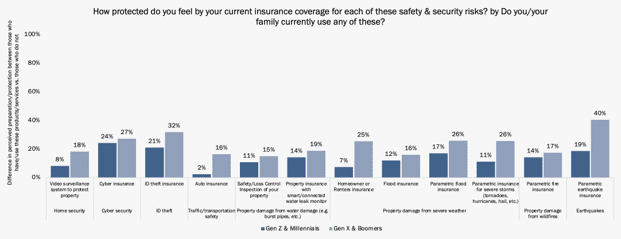
Safety and security coverage is widespread, but advanced parametric and prevention-oriented solutions play a disproportionate role in boosting confidence—especially when aligned to life stage and perceived exposure.
Parametric and prevention-oriented products are a major opportunity for insurers.
How can insurers know what products customers actually want?
Explicitly asking customers whether certain products would help them feel more prepared yields strong results. Among respondents who do not currently have these products, many believe they would materially improve their sense of protection—especially in financial and health-related areas.
Protection gaps are driven less by resistance and more by awareness, accessibility, and relevance. Customers are open to solutions when they are clearly connected to the risks they care about.
Lifestyle products customers believe would increase preparedness
Among customers who do not currently have these products, perceived helpfulness ratings indicate clear latent demand for lifestyle-related protection, particularly for health, caregiving, and life-stage transitions.
Across both generations, products tied to ongoing well-being and high-consequence life events receive the strongest ratings. Annual medical, dental, and vision checkups stand out as the most compelling solution, with high likelihood scores from both Gen Z & Millennials (3.9) and Gen X & Boomers (3.6). Long-term care insurance for aging or disabled relatives and smart-home–enabled protection for elderly occupants also score highly, emphasizing widespread concern about caregiving responsibilities—even among customers who have not yet adopted these solutions.
Generational differences suggest that Gen Z & Millennials are consistently more open to adopting lifestyle protection products across nearly every category. This cohort assigns higher likelihood ratings to fitness trackers, cancer or critical illness insurance, pet insurance, event cancellation coverage, and wedding insurance—indicating stronger receptivity to products that address experiential, family-related, or preventive risks.
Gen X & Boomers also see value in these offerings, but with more tempered enthusiasm, reflecting a more selective approach to incremental lifestyle coverage.
Figure 4: Products and services that could increase lifestyle preparedness/protection if used
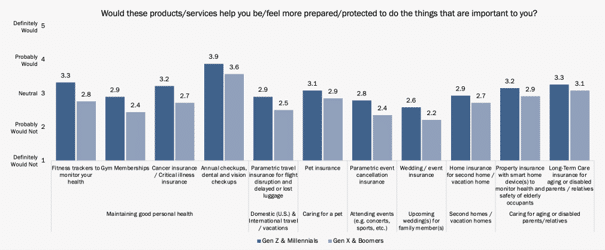
Overall, the findings reinforce that lack of adoption does not imply lack of interest; rather, many customers believe these products would help them feel more prepared if presented at the right moment and in the right context.
Financial products customers believe would increase preparedness
Customers who do not currently have this range of financial products indicate broad belief they would provide additional financial protection, particularly for healthcare, retirement, and long-term security risks.
Across both generational groups, health insurance–related solutions stand out the most. Health insurance, vision, and dental coverage receive the highest likelihood rating overall—particularly among Gen Z & Millennials (3.8 vs. 3.3)—highlighting persistent concern about healthcare affordability and access even before retirement. Retirement-focused products such as investments, annuities, and long-term care insurance also score strongly across both cohorts, reinforcing that retirement readiness and asset protection remain a top-of-mind gap even among those who have not yet adopted these solutions.
Generational differences reflect Gen Z & Millennials’ consistently higher openness to adopting additional financial protection, especially for products tied to proactive planning and cost control. This cohort rates college savings plans, usage-based auto insurance, smart-home–enabled insurance discounts, and employer-provided estate planning benefits more favorably than Gen X & Boomers—reflecting sensitivity to near- and mid-term financial pressures and interest in tools that offer flexibility and perceived value.
Gen X & Boomers, while still viewing most products as helpful, reflect a more even and measured response, with stronger alignment around Medicare-related coverage, long-term care insurance, and funeral or final expense insurance.
Figure 5: Products and services that could increase financial risk preparedness/protection if used
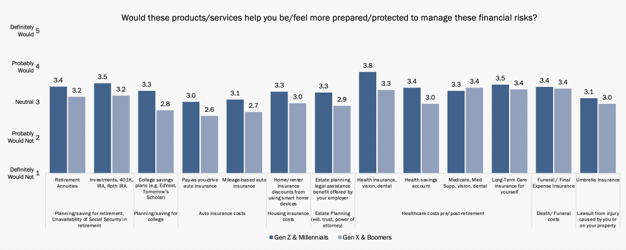
Overall, the findings reinforce that lack of adoption does not reflect lack of perceived value; rather, many customers—particularly younger ones—believe these financial products would increase their preparedness and provide cost-effective value if introduced at the right time, framed around their specific risks and needs.
Safety & security products customers believe would increase preparedness
Customers who do not currently have these safety and security products indicate confidence that they would improve preparedness to manage risks, with particularly strong belief in foundational protections.
Across both generations, auto insurance and homeowners/renters’ insurance receive some of the highest likelihood scores, reinforcing their role as essential foundational safeguards rather than discretionary add-ons. Notably, Gen Z & Millennials rate auto insurance as especially impactful (3.8 vs. 2.9), suggesting heightened sensitivity to financial exposure, given the increased cost of vehicles and repairs, even among those who may not currently have full or optimal coverage.
Beyond core products, both cohorts express meaningful interest in preventive and event-driven solutions, though with generational variation. Gen Z & Millennials consistently assign higher likelihood scores to flood insurance, parametric flood coverage, severe-storm protection, wildfire insurance, and earthquake insurance—indicating stronger receptivity to climate-related and parametric solutions when framed as preparedness enhancers. Gen X & Boomers also view these products as helpful, but with more moderated enthusiasm, reflecting a more traditional approach for adding incremental coverage.
Figure 6: Products and services that could increase safety and security risk preparedness/protection if used
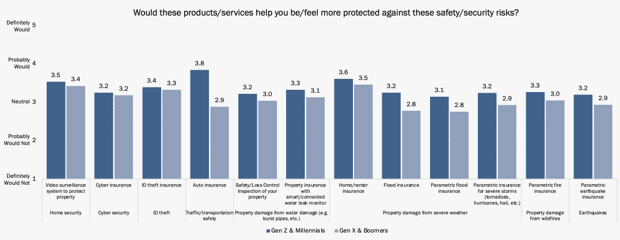
Across both generational segments, cyber and identity-related protections maintain steady appeal, reinforcing that safety and security concerns extend well beyond physical property and into digital risk.
Demand is high for expanded risk protection
Overall, the findings show latent demand exists across nearly all safety and security categories, with younger customers demonstrating particularly strong openness to expanding protection when risks are clearly articulated. This highlights a major opportunity for insurers to create and offer products that meet these needs, likely to position them differently as part of an overall financial plan.
Where do these findings leave insurers as they look forward?
- Insurers need to assess their ability to produce and market products that are in demand.
- They need to adapt traditional products in ways that make more sense to the customer, such as in the development of parametric solutions.
- They need to lean into system solutions that will help them operate efficiently while lowering risk through AI and better use of data.
Leading insurers assess and re-tool for the coming model years. They meet market demand with market-innovated products created with the help of market-leading solutions. Majesco helps insurers stay relevant by turning their innovative visions into innovative insurance products. For more information about how Majesco can help you, contact us today. And to get a new view on insurance customer sentiment, be sure to read Closing the Insurance Customer Protection Gap: How Generational Differences in Risk, Readiness, and Coverage Are Redefining Insurance Value.